
Colombia 2026 World Cup Squad: Los Cafeteros, a 28-Game Unbeaten Run, and the Miami Final Against Ronaldo
Colombia missed the 2022 World Cup. They finished sixth in CONMEBOL qualifying and failed to reach Qatar. It was a humiliation for a country that had reached the quarter-finals in 2014 and always considered itself one of South America's elite football nations.
What followed was one of the great rebuilding jobs in recent international football. Néstor Lorenzo took over in June 2022 and built a 28-match unbeaten run. He reached the 2024 Copa América final, losing to Argentina only in extra time when Lautaro Martínez scored in the 112th minute. He finished third in CONMEBOL qualifying with 28 points. He made James Rodríguez relevant again. He took Luis Díaz to Bayern Munich levels.
Then came March 2026. Back-to-back friendly defeats — 2-1 to Croatia, then 3-1 to a rotated France second string in Maryland. Defensively exposed. Tactically questioned. Lorenzo clear afterward that these were worrying results at exactly the wrong moment.
Group K. Uzbekistan, DR Congo, and Portugal. The closing fixture against Cristiano Ronaldo's Portugal in Miami could decide the group winners. Colombia arrive as one of the most dangerous sides in the tournament. The 28-match unbeaten run. The Copa America 2024 final appearance. Third in CONMEBOL qualifying with 28 points. And Luis Díaz, who just had one of the best individual seasons of any player in European football.
This is everything Colombia have been building toward.
The Coach: Néstor Lorenzo
Néstor Lorenzo was appointed head coach of the Colombia national team in June 2022, succeeding Reinaldo Rueda who had been dismissed in April after Colombia finished sixth in CONMEBOL qualifying and failed to reach the 2022 FIFA World Cup. He signed a four-year contract with the Colombian Football Federation, bringing his experience from club management in Peru and Argentina to revitalize the squad.
He is the only head coach at this year's World Cup who has played for Swindon Town. He spent 12 years as José Pékerman's assistant with Colombia. He knows this squad and this football culture better than almost any external appointment could.
Lorenzo usually opts for a 4-2-3-1 formation; his methods combine the free-flowing, relentless football Colombia knows and loves, and the pragmatic, street-wise style associated with Argentina, his homeland. His out-of-possession tactics mean Colombia sit in a mid-block and attempt to frustrate their opposition.
A key aspect of his tactical evolution was the revival of James Rodríguez, who had struggled for form and playing time prior to Lorenzo's arrival; Rodríguez became a central playmaker, contributing directly to goals at a rate of one every 127 minutes during the 2023-2024 period and earning praise as the tournament's best player at Copa América 2024.
His most controversial decision was leaving Jhon Durán out of the squad entirely for disciplinary reasons. He was direct about it. Selection decisions are based on performance and conduct. No exceptions. That clarity of standards is a significant part of why this squad has the discipline and collective identity it does.
The tactical system under Lorenzo is a 4-2-3-1 with a double pivot of Ríos and Jefferson Lerma behind Rodríguez, Díaz on the left, Arias on the right and Luis Suárez leading the line. The system relies on Díaz to be the primary threat and James to be the primary creator. When both are at their best, Colombia are a genuinely dangerous team at any level.
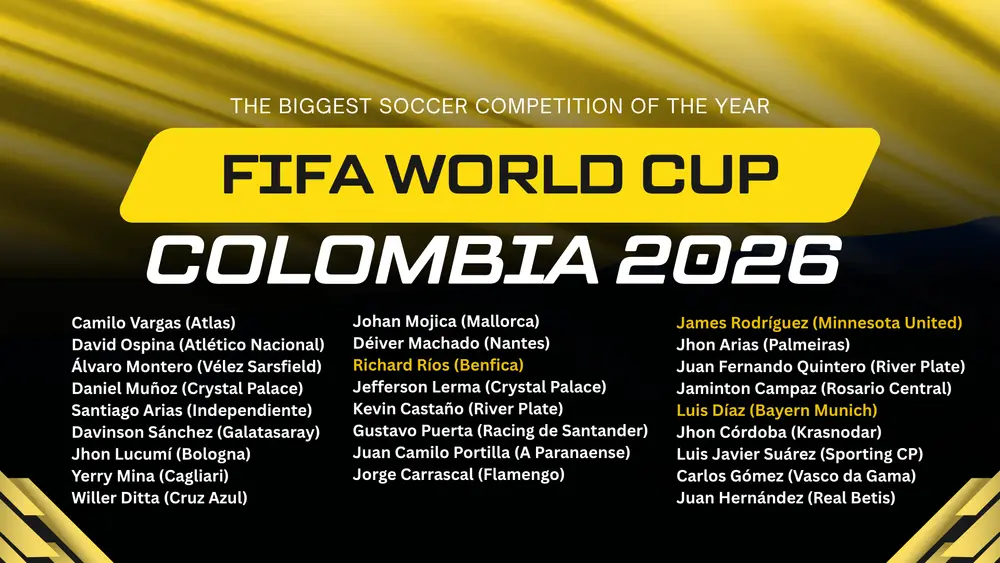
Goalkeepers
Camilo Vargas — Atlas
Colombia's first-choice goalkeeper. Vargas has been a consistent and commanding presence for the national team for several years, earning over 50 caps. His ability to organise the defensive line vocally and his shot-stopping quality under pressure make him the natural starter in Lorenzo's system.
David Ospina — Atlético Nacional
The legendary veteran who has returned home to Atlético Nacional after a career that took him to Arsenal, Napoli, and Al-Qadsiah. Ospina's experience, leadership, and knowledge of the squad are invaluable as backup. This may be his farewell to international football.
Álvaro Montero — Vélez Sarsfield
The third-choice goalkeeper provides depth and competition. Montero's Argentine league experience gives him a high tactical understanding of the defensive positioning demands Lorenzo expects.
Defenders
Davinson Sánchez — Galatasaray
The defensive leader. Sánchez has been one of the most physically dominant centre-backs in the squad since his breakthrough at Ajax. His Galatasaray spell has kept him sharp and competing against quality opposition. Alongside Yerry Mina, he forms one of the most physically imposing centre-back partnerships at this tournament — tall, aggressive, commanding in the air.
Yerry Mina — Cagliari
Powerful, aerial, and excellent at reading danger before it develops. Mina's injury record has always been the concern — when fit, he is one of the best defenders Colombia have produced in a generation. His return to Serie A with Cagliari has kept him competitive and match-sharp heading into the tournament.
Johan Mojica — Mallorca
The first-choice left back whose ability to get forward and deliver from wide positions gives Colombia an additional attacking dimension. Mojica's La Liga experience and understanding of Lorenzo's system make him an automatic starter on the left side of the back four.
Daniel Muñoz — Crystal Palace
The right back whose Premier League performances have made him one of the most dynamic wide defenders in the squad. Muñoz's energy, crossing ability, and willingness to overlap give Colombia width and directness on the right flank. His combination with Jhon Arias ahead of him on the right side is one of Colombia's key attacking patterns.
Santiago Arias — Independiente
Experienced right back who provides depth and competition behind Muñoz. Arias's international experience and reading of the game make him a reliable option if Muñoz picks up an injury.
Jhon Lucumí — Bologna
Serie A centre-back whose development at Bologna under Thiago Motta and then the club's new coaching staff has been impressive. Lucumí brings technical quality on the ball that gives Lorenzo the option to shift to a more possession-based build-up when needed.
Willer Ditta — Cruz Azul
Physical defensive option with Liga MX experience. Ditta's composure and strength give Lorenzo a different profile at centre-back — more direct, less comfortable on the ball, but excellent in defensive duels.
Déiver Machado — Nantes
Left-sided defensive cover who provides depth behind Mojica. Machado's Ligue 1 experience and understanding of European-level tactical demands make him a reliable backup option.
Midfielders
Richard Ríos — Benfica
One of the most important players in Lorenzo's system. Ríos's energy, ball-winning ability, and composure under pressure make him the engine of the double pivot alongside Lerma. His move to Benfica has given him Champions League-level experience that the national team setup benefits from enormously. His stamina and energy are seen as two of his biggest strengths — for Colombia, where he is asked to protect the back line, that will be viewed as a strength.
Jefferson Lerma — Crystal Palace
The defensive anchor alongside Ríos. Lerma's physicality, experience, and relentless pressing intensity have made him one of the most consistent performers for Colombia under Lorenzo. His Premier League experience gives him the tactical discipline to sit in the double pivot and protect the back four without being drawn out of position.
James Rodríguez — Minnesota United
James Rodríguez, now 34 years old and playing at Minnesota United in MLS specifically to get regular minutes before the World Cup, remains Colombia's most gifted creative player when he is physically available and mentally engaged. His ability to find passes that nobody else sees, his movement between lines, and his set-piece delivery are still elite. When James is on, Colombia are on. Lorenzo specifically chose to revive him and it has worked — Copa América 2024 best player, the creative heart of a squad that reached the final.
Jhon Arias — Palmeiras
The most dynamic wide option in the squad. Arias's pace, directness, and ability to beat defenders in one-on-one situations give Colombia a constant threat on the right flank. His Brazilian football education at Fluminense and now Palmeiras has made him one of the most complete wide midfielders in South American football.
Kevin Castaño — River Plate
Technical central midfielder who provides depth behind the Ríos-Lerma partnership. Castaño's River Plate experience and composure on the ball give Lorenzo a different option when Colombia need to control possession rather than press and win the ball back quickly.
Gustavo Puerta — Racing de Santander
Young midfielder developing in Spain whose technical quality and pressing intensity have caught the attention of European clubs. His inclusion gives Colombia depth in midfield and the national team setup experience he needs for the next cycle.
Juan Camilo Portilla — Athletico Paranaense
Creative wide option who provides variety in how Colombia approach wide attacking positions. Portilla's Brazilian football experience and ability to combine in tight spaces give Lorenzo a different dimension from the bench.
Jorge Carrascal — Flamengo
One of the most technically gifted players in the squad. Carrascal's dribbling, creativity, and ability to make something happen from nothing give Lorenzo an impact option when the game needs changing. His Flamengo form in Brazil has been outstanding and his inclusion reflects how valuable his individual quality is even in a squad this deep.
Jaminton Campaz — Rosario Central
Direct, pacy wide midfielder who scored Colombia's consolation goal in the 3-1 friendly defeat to France in March. Campaz's willingness to run at defenders and create chaos in transition gives Lorenzo a specific option when Colombia need to change tempo in the second half.
Forwards
Luis Díaz — Bayern Munich
The best player in this squad and one of the best wide forwards in world football. Díaz's move from Liverpool to Bayern Munich confirmed his status among the elite. His pace, dribbling, pressing intensity, and ability to score from wide positions make him Colombia's most dangerous attacking weapon. The system relies on Díaz to be the primary threat and James to be the primary creator. When both are at their best, Colombia are a genuinely dangerous team at any level. When Díaz is isolated or James is not finding the game, Colombia can become more predictable. Everything flows through these two.
Luis Javier Suárez — Sporting CP
The striker who leads the line in Lorenzo's 4-2-3-1. Suárez's movement, hold-up play, and ability to score in tight spaces make him the natural focal point of the attack. His Sporting CP experience in Portugal gives him the tactical intelligence to work in the channels and bring James and Díaz into play effectively.
Jhon Córdoba — Krasnodar
Physical centre-forward option who gives Lorenzo a completely different profile when Colombia need to play more directly. Córdoba's aerial ability and strength in the box make him dangerous from set pieces and when Colombia want to play over a defensive block.
Juan Camilo "Cucho" Hernández — Real Betis
One of the most exciting forwards in Spanish football. Cucho's creativity, dribbling in tight spaces, and ability to score from unexpected positions make him a dangerous option from the bench. His Real Betis form has been outstanding — direct, unpredictable, and capable of the kind of individual moment that changes a tournament.
Carlos Gómez — Vasco da Gama
Young forward developing quickly in Brazilian football. His inclusion reflects Lorenzo's interest in building for the future even as this squad targets deep tournament progress. Pace and directness are his primary weapons.
Colombia's Group K Schedule: Three Games Across Mexico and Miami
Colombia face Uzbekistan first in Mexico City, then DR Congo in Zapopan, before the group-deciding clash against Portugal in Miami.
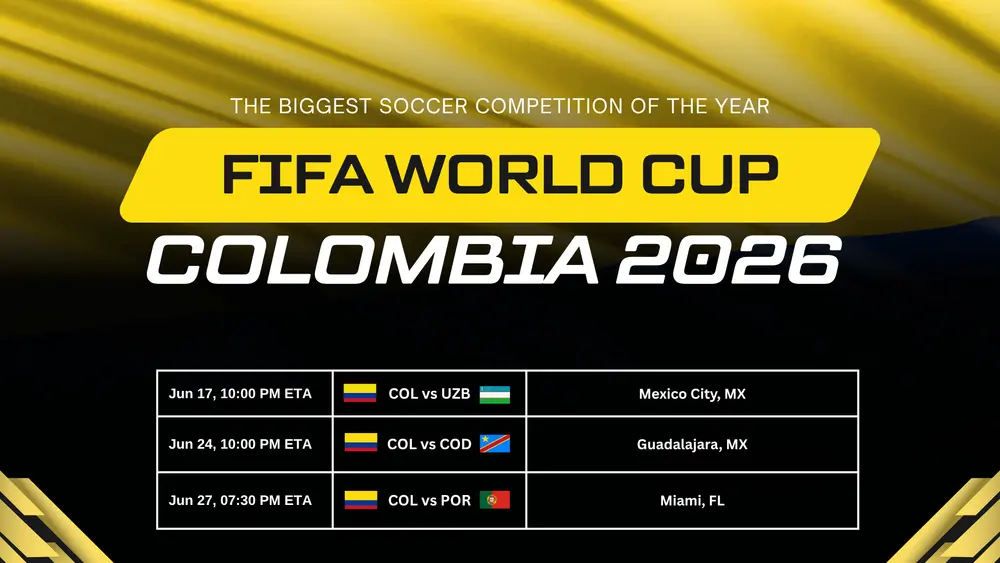
Both opening games are in Mexico — Colombia's first continental neighbours and a country where Colombian football culture translates directly into crowd support. Uzbekistan and DR Congo are both winnable. The closing fixture against Cristiano Ronaldo's Portugal in Miami could decide the group winners.
Ronaldo at 41, playing his sixth World Cup. James Rodríguez at 34, playing what is likely his last. One of the iconic individual matchups of the group stage will happen in Miami on June 27.
What Colombia Actually Need to Do
Uzbekistan and DR Congo should be won. Six points from the first two games and Colombia top the group going into Miami with nothing to lose.
If that happens, the Portugal game becomes the most watched match of Group K. James Rodríguez versus a Portuguese midfield. Luis Díaz against Nélson Semedo or Diogo Dalot. Cucho Hernández off the bench against a back four that has been managing Ronaldo's demands for two weeks.
Expect Lorenzo's men to reach at least the last 16. The talent is there. The system is proven. The unbeaten run, the Copa América final, the CONMEBOL qualifying record — this squad knows how to perform in big moments.
The question is whether the March defeats exposed a vulnerability that opponents at this level will exploit. Croatia found it. France found it. If Portugal find it too, Colombia go home in the group stage for the second consecutive World Cup.
If they don't — if James is on form, if Díaz is unplayable, if Ríos and Lerma protect the back four the way they did throughout qualifying — Colombia are dark horse contenders for the quarter-finals and beyond.
📋 Download the Full Colombia Squad PDF
All 26 players, clubs, positions and the Group K schedule in one clean printable page.
⬇ Download Colombia 2026 World Cup Squad PDF