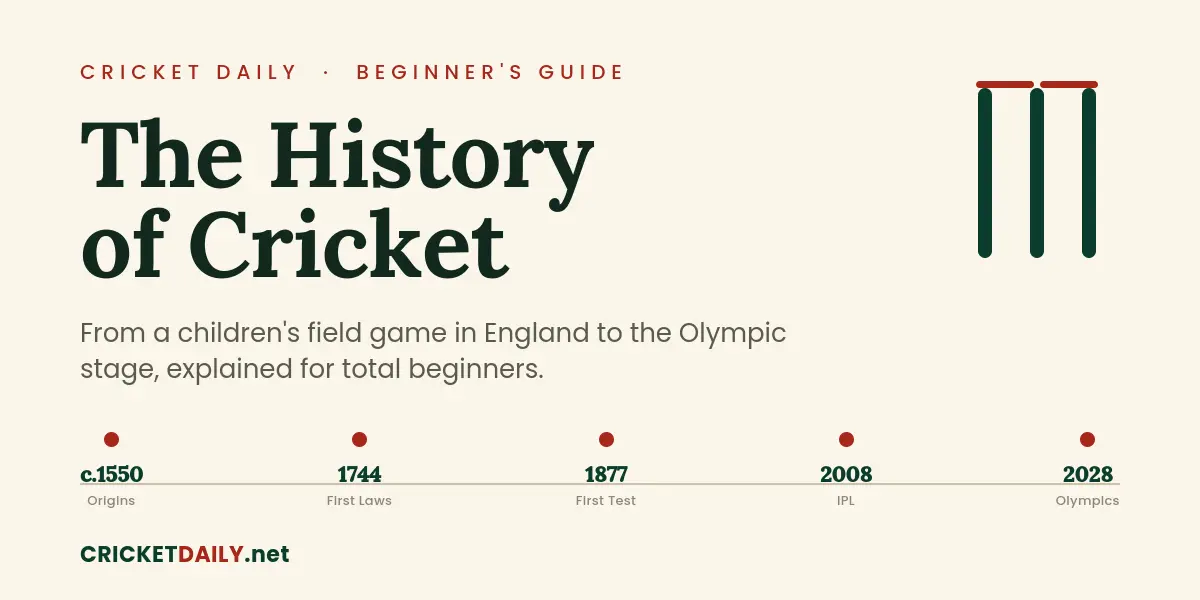
The History of Cricket: From a Children’s Field Game to the Olympic Stage
By Ra Young, Cricket Daily
Cricket is one of the most watched sports on the planet, with billions of fans across India, England, Australia, Pakistan, South Africa, the Caribbean, and beyond. Yet it started as a rough game played by children in the fields of southern England more than 450 years ago.
This is the story of how that field game grew into the sport that fills 100,000-seat stadiums today. No prior knowledge needed. If you have never watched a match in your life, you are exactly who this guide is for.
Cricket in one minute: what you actually need to know
Before the history makes sense, here is the game in plain terms.
Cricket is a bat-and-ball sport played between two teams of eleven players. At the center of the field is a strip of flat ground called the pitch, which is 22 yards long (about 20 meters). At each end of the pitch stand three wooden posts called stumps. The stumps are the target.
One team bats and the other team bowls (their version of pitching, except the ball usually bounces off the ground first). A bowler tries to hit the stumps or get the batter out. A batter tries to hit the ball and run to the other end to score points, which are called runs. Every time a batter is dismissed, that is a wicket. Once ten of the eleven batters are out, the teams swap roles.
The team with the most runs at the end wins. That is the whole game in a nutshell. Everything below is how the world got from a muddy English field to that.
Where cricket came from: a game on the village green
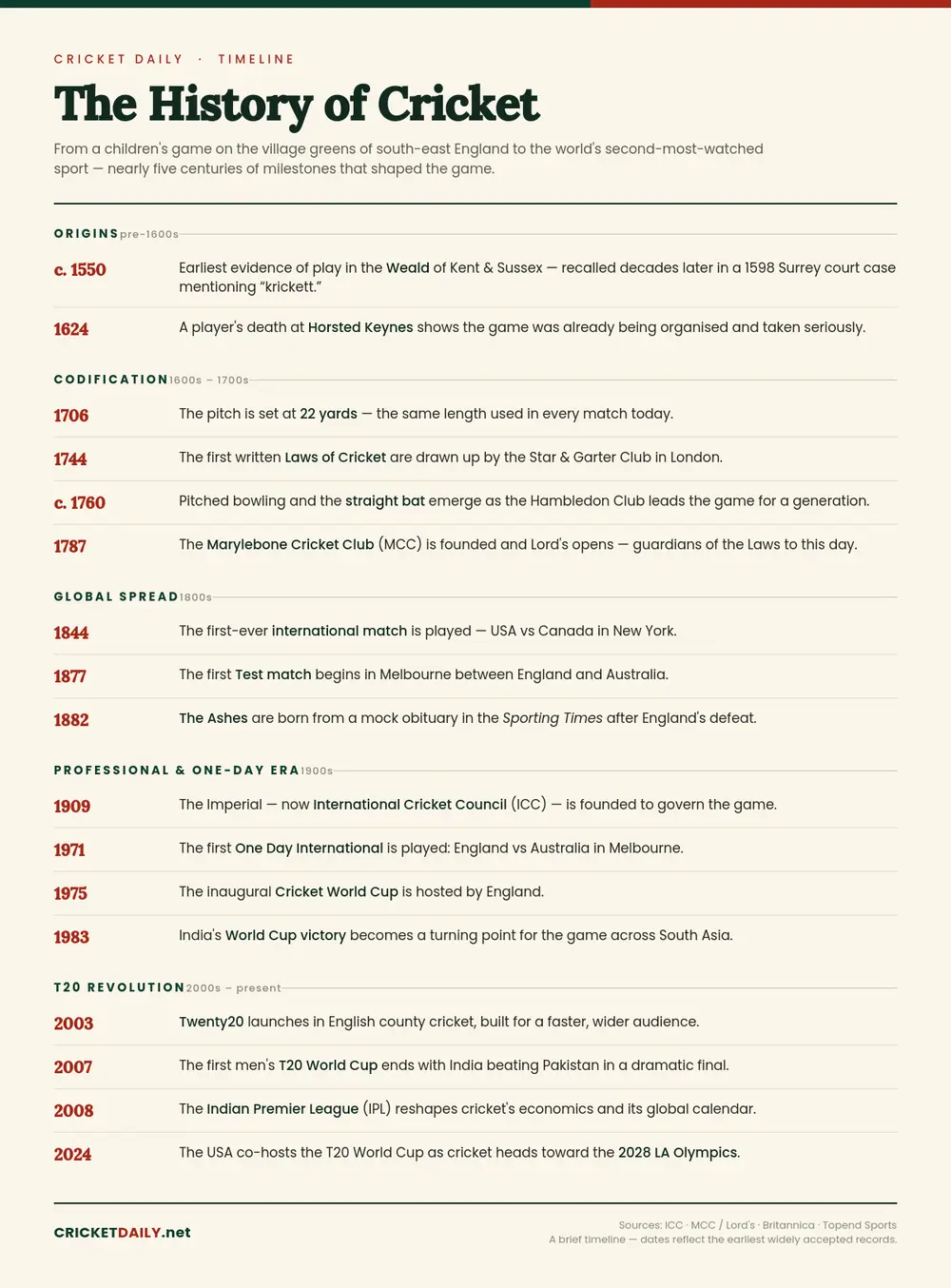
Cricket’s exact birthday is a mystery, which is part of its charm. The best evidence points to children playing a bat-and-ball game in the Weald, a wooded region across the English counties of Kent and Sussex, sometime in the 1500s.
The oldest solid clue comes from a court case in Guildford, Surrey, in 1598. A man testified that he had played“krickett” on a piece of common land as a boy, which places the game in England by roughly 1550. The word itself probably came from an old term for a stick or a staff, borrowed from either Old English or the languages spoken across the nearby European coast.
For a long time cricket stayed a local pastime. Adults gradually took it over from children, and by the 1600s it was organized enough that money and pride were on the line. We even know it was played seriously because records survive of disputes and injuries tied to matches. You can read more on the game’s earliest days in the ICC’s history pages and this overview from CricketerGuru.
How cricket got its rulebook: the 1600s and 1700s
A game cannot spread far without agreed rules, and this is the era when cricket got them.
By the early 1700s the pitch had settled at its familiar 22-yard length. Then in 1744 came a landmark moment: the first written Laws of Cricket. They were drawn up by a group of wealthy patrons known as the Star and Garter Club, and they set out how the game should be played and how arguments should be settled.
Around 1760, the game changed shape on the field too. Bowlers started bouncing the ball off the ground instead of rolling it, and batters swapped their old hockey-stick-shaped bats for the straight bat we recognize today.
The most important institution arrived in 1787, when the Marylebone Cricket Club, known as the MCC, was founded in London. The MCC set up its home at Lord’s, still called the “home of cricket,” and it took charge of the Laws. Remarkably, the MCC remains the guardian of cricket’s Laws to this day. You can see this history told by the club itself on the MCC and Lord’s site.
How cricket went global: the 1800s
Cricket left England the way many British things did in the 1800s: it traveled with the British Empire. Soldiers, traders, and settlers carried the game to India, Australia, the Caribbean, southern Africa, and elsewhere.
It did not catch on everywhere equally. In some places it faded, but in India, Australia, and the West Indies it took deep root and eventually outgrew the country that invented it.
Three moments from this century still matter today.
In 1844, the first international match was played, and the two teams were not England and anyone. They were the United States and Canada, who met in New York. This surprises almost everyone.
In 1877, the first Test match was played in Melbourne between England and Australia. A Test is the oldest and longest form of the game, and the name has stuck ever since (more on formats below).
In 1882, one of sport’s great rivalries was born. After Australia beat England on English soil for the first time, a British newspaper printed a mock obituary joking that English cricket had died and its ashes would be taken to Australia. The two nations have played for a trophy called the Ashes ever since. For a plain-English timeline of these milestones, Topend Sports is a handy reference.
The one-day revolution: cricket in the 1900s
For most of its life, cricket was a slow, multi-day affair. The 1900s changed that.
First came organization. In 1909 the game got a global governing body, originally the Imperial Cricket Conference and now the International Cricket Council, or ICC. Today it oversees more than 100 member countries.
Then came speed. In 1971 the first One Day International was played, a match designed to finish in a single day rather than five. It was an instant hit with crowds who did not have days to spare.
The one-day format got its showcase in 1975 with the very first Cricket World Cup, held in England. And in 1983, India won the World Cup in a stunning upset. That victory turned cricket into a national obsession across South Asia and shifted the sport’s center of gravity toward the subcontinent, where it largely remains.
The T20 era: cricket in the 2000s and beyond
If the 1900s made cricket faster, the 2000s made it explosive.
In 2003, England launched a brand-new format called Twenty20, or T20. Each side gets just 20 overs (an over is six deliveries), which packs a full contest into roughly three hours. It was built for big hitting and evening crowds, and it worked.
In 2007, the first men’s T20 World Cup ended with India beating Pakistan in a dramatic final, proving the short format could carry a global tournament. You can read the ICC’s own recap of that first edition here.
The real earthquake came in 2008 with the launch of the Indian Premier League, or IPL. The IPL turned cricket into a franchise business, with city-based teams, star players auctioned for huge sums, and television deals to match. It reshaped the sport’s money and its calendar, and it inspired a global circuit of leagues from Australia to the Caribbean. For a beginner-friendly look at how T20 grew, this history of the format is a good starting point.
Cricket is still growing. In 2024, the United States co-hosted a men’s T20 World Cup, and the sport is set to return to the Olympic Games in Los Angeles in 2028. Britannica’s overview of T20 cricket covers this modern chapter.
The three formats, explained simply
Newcomers are often confused that cricket seems to have several versions. It does, and here is the difference in one place.
A Test match is the original long form. It can last up to five days, and it is still seen as the ultimate test of a player’s skill and patience. This is where the traditional all-white clothing comes from.
A One Day International (ODI) is limited to 50 overs per side and finishes in a single day. World Cups have traditionally been played in this format.
A Twenty20 (T20) is the shortest form at 20 overs per side, wrapping up in about three hours. It is the fastest, loudest, and most popular version with new fans.
All three are played today, and each has its own world championship. If you are watching your first match, a T20 is the easiest way in.
Frequently asked questions about cricket’s history
Where was cricket invented? Cricket was invented in south-east England, most likely in the counties of Kent, Sussex, and Surrey, sometime before 1550. It probably began as a children’s game and grew from there.
How old is cricket? The first firm evidence dates to a 1598 court case that refers to the game being played around 1550, which makes cricket well over 450 years old.
What was the first international cricket match? The first international match was played in 1844 between the United States and Canada in New York, more than 30 years before the first Test match.
What is the difference between Test, ODI, and T20 cricket? Length. A Test lasts up to five days, an ODI is 50 overs per side in one day, and a T20 is 20 overs per side in about three hours. T20 is the shortest and most beginner-friendly.
When did T20 and the IPL start? The T20 format launched in England in 2003, the first men’s T20 World Cup was held in 2007, and the Indian Premier League began in 2008.
Start watching
Cricket has spent nearly five centuries turning from a rough village game into a sport that is heading back to the Olympics. The traditions you see today, from the white clothing in Tests to the fierce England-Australia rivalry, are living links to that long history.
The best way to understand any of it is to watch a match, and the easiest place to start is a T20. For the latest scores, explainers, and stories from across the cricket world, keep exploring Cricket Daily.


