The Rules of Cricket, Explained Simply: A Beginner’s Guide to How the Game Works
By Ra Young, Cricket Daily
Cricket looks complicated from the outside. There are white-clad players scattered across a huge field, a match can last anywhere from three hours to five days, and the commentary is full of words like “silly mid-on” and “maiden over.”
Here is the good news. The core of cricket is simple, and you can learn enough to enjoy a match in about ten minutes. This guide breaks the rules down in plain language, with no jargon left unexplained. If you have never watched a game, start here.
The goal of cricket in one sentence
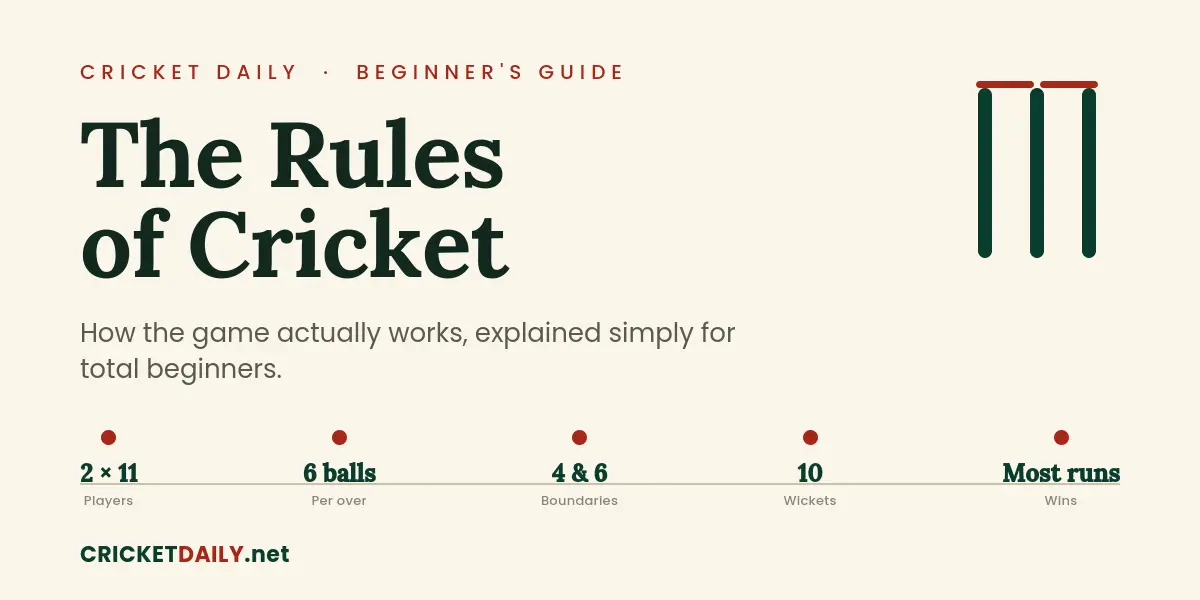
Two teams take turns batting and bowling, and the team that scores the most runs wins.
That is the entire game. A run is cricket’s version of a point. One team tries to score as many runs as possible while it bats, and the other team tries to stop them and get them out. Then they swap. Everything below is just detail that hangs off that one idea.
The field, the pitch, and the equipment
A cricket field is large and usually oval, ringed by a boundary rope. In the middle is the part that matters most: a flat strip called the pitch, which is 22 yards long (about 20 meters).
At each end of the pitch stand three wooden posts calledstumps, with two small pieces of wood called bails resting on top. The three stumps and two bails together are known as the wicket. The wicket is the target that bowlers aim at and batters defend.
The gear is straightforward: a hard leather ball, a flat wooden bat, and protective pads, gloves, and a helmet for the batter, since that ball is thrown hard.
Two teams, two roles: batting and fielding
Each team has eleven players. At any moment one team is batting and the other is fielding.
The batting side sends out two batters at a time, one at each end of the pitch. Their job is to score runs and avoid getting out.
The fielding side has all eleven players on the field. One of them, the bowler, delivers the ball toward the batter. Another, the wicketkeeper, crouches behind the stumps to catch anything the batter misses. The other nine spread out to stop the ball and catch it.
A bowler does not throw the ball like a baseball pitcher. The bowler runs in and delivers the ball with a straight arm, and it usually bounces once off the pitch before reaching the batter.
How you score runs
There are two ways for the batting team to score.
The first is by running. After hitting the ball, the two batters can run to swap ends of the pitch. Each completed swap is worth one run. If they have time, they can run back and forth more than once for two, three, or more runs.
The second is by hitting a boundary. If the ball reaches the boundary rope after touching the ground, that is worth four runs. If it clears the rope without bouncing, like a home run, that is worth six runs. Boundaries are the fastest way to pile up a score, which is why big hitting draws such big crowds.
What an “over” is
You will hear the word “over” constantly, so it is worth thirty seconds.
An over is a set of six legal deliveries bowled from one end of the pitch. After six balls, that over is finished, a different bowler takes over from the opposite end, and the process repeats. The same bowler cannot bowl two overs in a row.
Overs are how cricket measures the length of a game. A Twenty20 match gives each team 20 overs. A One Day International gives each team 50 overs. The word “legal”matters here, because some deliveries do not count, which brings us to extras in a moment.
The main ways a batter gets out
Getting a batter out is called taking a wicket (yes, the same word as the stumps). The fielding side needs ten wickets to end the other team’s innings. An innings is simply the period during which one team bats.
The official Laws of Cricket, maintained by the Marylebone Cricket Club, list ten ways to be dismissed. In practice you will mostly see these five or six:
Bowled. The bowler’s delivery hits the stumps and knocks the bails off. Clean and final.
Caught. The batter hits the ball into the air and a fielder catches it before it lands. This is the most common dismissal.
Leg Before Wicket (LBW). The ball hits the batter’s leg (usually the pad) when it would otherwise have gone on to hit the stumps. The umpire has to judge the ball’s path, which is why this one causes the most arguments.
Run out. While the batters are running, a fielder breaks the stumps with the ball before a batter reaches the safe area, called the crease. If any part of the bat or body is grounded behind the crease line, the batter is safe.
Stumped. The batter steps out of the crease to play a shot, misses, and the wicketkeeper breaks the stumps before they can get back.
Hit wicket. The batter accidentally knocks their own stumps with the bat or body while playing a shot.
There are rarer ways too, such as obstructing the field, which the MCC clarified again in 2026, but you can happily ignore those until you have watched a few matches.
Extras: free runs the fielding side gives away
Sometimes the batting team scores without the batter doing anything. These are called extras.
A wide is a ball bowled too far from the batter to hit fairly. A no-ball is an illegal delivery, most often because the bowler’s front foot lands past the line. Both a wide and a no-ball give the batting team a free run, and the delivery usually has to be bowled again, so it does not count toward the over.
There are also byes and leg byes, which are runs the batters take when the ball gets past them without being hit. You do not need to memorize these. Just know that a score can tick up even when the bat never touches the ball.
Who is in charge: umpires and the review system
Two umpires stand on the field and make the decisions: whether a batter is out, whether a delivery was a wide or a no-ball, and how many runs were scored.
In televised professional matches, teams can challenge some decisions using the Decision Review System (DRS). It uses ball-tracking technology to check close calls, especially LBW. If you see a batter or fielder make a “T” shape with their arms, they are asking for a review.
How a match is won, and the three formats
A team wins by scoring more runs than the opponent. How that plays out depends on the format, and cricket has three main ones.
Test cricket is the long form, played over up to five days in traditional white clothing. Each side usually bats twice.
One Day Internationals (ODIs) give each team 50 overs and finish in a single day. This is the classic World Cup format.
Twenty20 (T20) gives each team just 20 overs and wraps up in about three hours. It is the fastest and most beginner-friendly version, full of big hitting.
If you want the backstory of how these formats came to be, our history of cricket guide walks through the whole journey.
Frequently asked questions about the rules of cricket
How many players are on a cricket team? Each team has eleven players. The batting side has two batters on the field at once, while the fielding side has all eleven out there.
How long is a cricket match? It depends on the format. A T20 lasts about three hours, an ODI takes a full day, and a Test match can run up to five days.
How do you score in cricket? By running between the wickets after hitting the ball, or by hitting a boundary. A boundary along the ground is four runs, and one hit over the rope on the full is six runs.
How many ways can you get out in cricket? The Laws list ten methods of dismissal, but almost every dismissal you will see is one of six: bowled, caught, LBW, run out, stumped, or hit wicket.
What is an over in cricket? An over is six legal deliveries bowled from one end. Wides and no-balls do not count, so they are bowled again.
Who makes the rules of cricket? The Marylebone Cricket Club (MCC) owns and maintains the Laws of Cricket, while the International Cricket Council (ICC) governs the professional game.
Start watching
You now know enough to follow a match: two teams, runs, overs, wickets, and boundaries. The rest of the detail will sink in naturally the more you watch.
The easiest place to start is a T20 game, where the action is quick and the scoring is constant. For more beginner guides, live scores, and explainers, keep exploring Cricket Daily.


