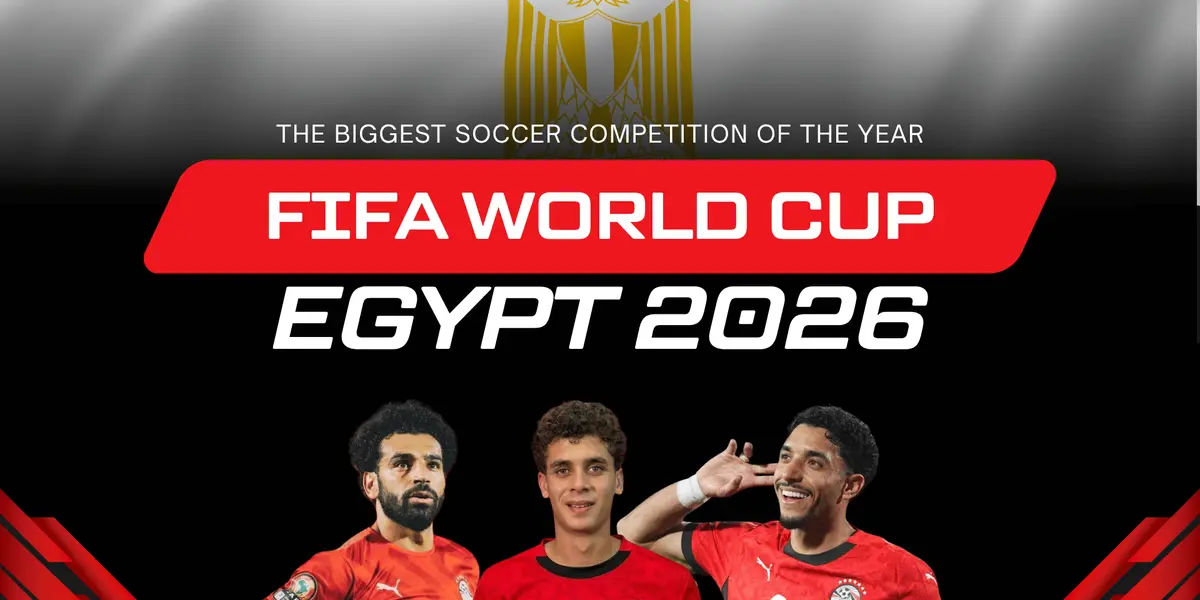
Egypt 2026 World Cup Squad: The Pharaohs, Mohamed Salah's Final Tournament, and Hunting a First-Ever World Cup Victory
Egypt have appeared at three World Cups — 1934, 1990, and 2018. They have never won a match.
That record has defined Egyptian football's relationship with the tournament for nearly a century. Seven Africa Cup of Nations titles — the most in African history — and total anonymity on the global stage. 2018 was Mohamed Salah's first World Cup, but injury limited his impact and Egypt came home with three defeats and zero points.
Now comes 2026. Salah leads them back. He turns 34 on June 15, the exact same day Egypt open their tournament against Belgium in Seattle. He has departed Liverpool as a Reds legend — 67 international goals across 116 caps, the greatest Egyptian footballer who ever lived. And alongside him, Omar Marmoush at Manchester City, one of the most in-form attacking players in Europe.
Coach Hossam Hassan — Egypt's all-time top scorer with 69 international goals, the man who played at the 1990 World Cup — has become the first person in history to take Egypt to a World Cup as both a player and as head coach. He guided an unbeaten CAF qualifying campaign: eight wins, two draws, zero defeats, only two goals conceded across 10 matches.
Group G. Belgium. New Zealand. Iran. The final group game against Iran could prove decisive for a maiden knockout berth.
This is Egypt's best chance to rewrite history. Salah knows it. Hassan knows it. The entire country knows it.
The Coach: Hossam Hassan
Hossam Hassan took charge in February 2024. He built a lengthy coaching career with several Egyptian clubs, including Zamalek, and also spent time managing Jordan in 2013. Few coaches understand the weight of the Egypt shirt better, having worn it for two decades as a striker.
His Egypt are built on a solid defensive block and quick transitions that release Salah and Marmoush. The structure is built on a compact, disciplined 4-2-3-1 or 3-4-1-2 depending on the opponent, with the emphasis on defensive organization first and releasing Mohamed Salah and Omar Marmoush into the spaces their quality can exploit.
Hassan leans on the Al Ahly core — eight players come from the Egyptian champions — for structure and trusts a small group of Europe-based players to raise the level. The squad leans heavily on the domestic league, with only nine of the 26 plying their trade abroad. Hassan has defended that decision publicly. Egypt's defensive record across CAF qualifying was outstanding: seven clean sheets, only two goals conceded in 10 matches.
He didn't shy from bold calls — picking 18-year-old Hamza Abdel Karim over more established strikers, confirming that this tournament is about the future as much as Salah's farewell.
Expected Formation: 4-2-3-1
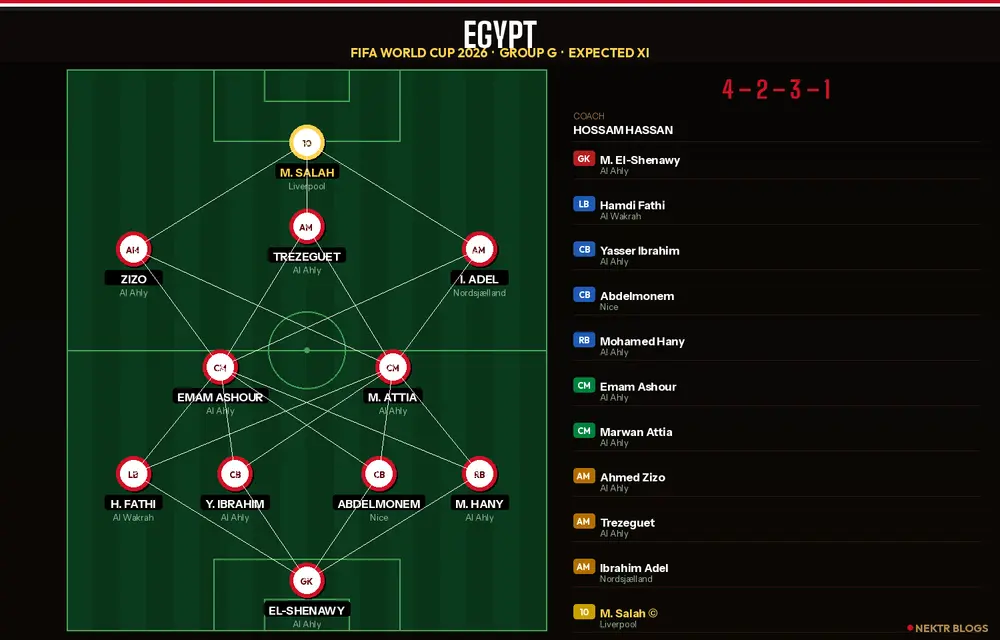
Salah operates as a free-ranging number ten, dropping deep to receive, driving at defenders, and creating or finishing. Marmoush provides the alternative to Salah as striker when Hassan wants a more physical presence. The defensive block is compact — Emam Ashour and Marwan Attia screen, the back four sits narrow, and the full-backs pick their moments to advance rather than pushing forward freely.
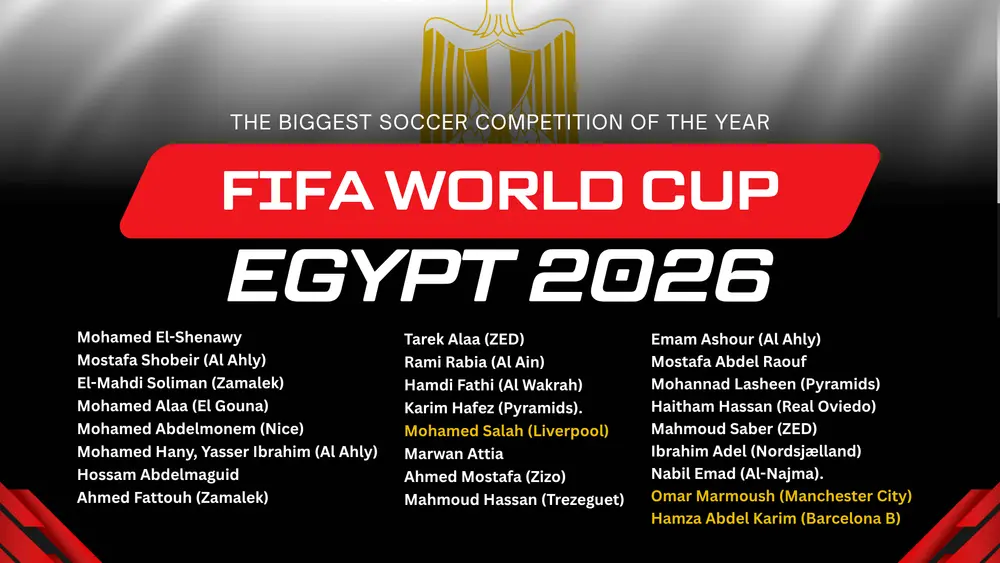
Goalkeepers
Mohamed El-Shenawy — Al Ahly
Egypt's first-choice goalkeeper for over a decade. El-Shenawy's composure, shot-stopping ability, and command of the penalty area have made him one of the most respected goalkeepers in African football. His 2018 World Cup experience gives Hassan a leader in goal who knows what this tournament demands. At 36, this is almost certainly his final World Cup too.
Mostafa Shobeir — Al Ahly
Highly regarded backup who has developed behind El-Shenawy at Al Ahly. Shobeir's technical quality and positional assurance make him a genuine heir to the number one jersey for the next cycle of Egyptian football.
El-Mahdi Soliman — Zamalek
Third-choice goalkeeper with experience at Egypt's second-biggest club. His familiarity with big-match pressure in Egyptian domestic football makes him a reliable third option.
Defenders
Mohamed Abdelmonem — Nice
The standout European-based defender in the squad. Abdelmonem's Ligue 1 experience at Nice has given him a tactical education that most of his teammates in the back four have not had. His composure on the ball, aerial ability, and reading of movement from European-level forwards make him Egypt's most technically complete defender.
Mohamed Hany — Al Ahly
Experienced right back who has been part of the national team setup for several years. Hany's defensive discipline and understanding of Hassan's compact system make him a reliable option at right back — defensively sound without being adventurous going forward.
Yasser Ibrahim — Al Ahly
Left-sided centre-back whose partnership with Abdelmonem in the middle of Egypt's back four has been central to the clean sheet record during qualifying. Ibrahim's physical presence, aerial strength, and ability to organise the defensive line give Hassan a vocal leader at the heart of the defence.
Hamdi Fathi — Al Wakrah
Left back with Qatar Stars League experience. Fathi's discipline, positioning, and ability to recover quickly make him the reliable option on the left side of Egypt's defensive four.
Ahmed Fattouh — Zamalek
Experienced domestic defender who provides depth across the back four. Fattouh's understanding of Hassan's system and his composure under pressure make him a trusted squad option.
Tarek Alaa — ZED
Centre-back option with domestic league experience. His physicality and aerial ability give Hassan a different profile at the back when facing physical opponents.
Rami Rabia — Al Ain
UAE-based defender with international experience. Rabia's time in the Gulf gives him exposure to high-pressure football across multiple competitions and makes him a reliable defensive squad member.
Karim Hafez — Pyramids
Young centre-back developing quickly in the Egyptian Premier League. His inclusion represents Hassan's interest in building the next generation of defensive options for the national team.
Hossam Abdelmaguid — Zamalek
Physical and aggressive defensive option with Zamalek experience. Abdelmaguid's strength in duels and aerial dominance give Hassan a different defensive dimension when the game requires a more direct approach.
Midfielders
Emam Ashour — Al Ahly
The midfield engine. Ashour's ability to win the ball, disrupt opponents' rhythm, and recycle possession quickly is central to how Hassan's defensive block functions. His understanding of the Al Ahly pressing system translates directly into the national team's approach — compact, physical, and relentless in winning second balls.
Marwan Attia — Al Ahly
Box-to-box midfielder who provides the dynamism alongside Ashour. Attia's energy, pressing intensity, and ability to arrive late into attacking areas give Egypt a threat from deep that opponents must account for. His Al Ahly foundation gives him a tactical understanding of Hassan's system from day one.
Ahmed Zizo — Al Ahly
Creative attacking midfielder who provides the link between Egypt's midfield and attack. Zizo's close control, movement in tight spaces, and ability to play the final pass are essential in unlocking defences that sit deep against Egypt. His Al Ahly form has been outstanding and his international experience makes him one of the most trusted options in Hassan's attacking setup.
Mahmoud Hassan "Trezeguet" — Al Ahly
Named after the French World Cup winner for his instinctive goal-scoring ability from midfield areas. Trezeguet's late runs, positioning, and big-game temperament make him a consistent threat from the right side of Egypt's attacking four. His AFCON and African Champions League experience means he understands what tournament football demands.
Ibrahim Adel — Nordsjælland
The most European-experienced player in Egypt's midfield. Adel's development at Nordsjælland in the Danish Superliga has given him a technical and tactical education that the majority of his nationally-based teammates have not had. His composure on the ball, pressing intelligence, and ability to operate in tight spaces at high tempo make him one of Egypt's most important young players.
Mostafa Abdel Raouf — Pyramids
Technical midfielder known as "Ziko" for his dribbling flair. Abdel Raouf's ability to create in tight spaces and find teammates in dangerous positions gives Hassan a creative option when Egypt need to unlock a low block through individual quality rather than speed.
Mohannad Lasheen — Pyramids
Physical and direct midfield option who provides a different profile to the more technical players around him. Lasheen's pressing from the front and ability to cover ground in transition make him a useful option when Hassan wants to change the game's tempo from the bench.
Haitham Hassan — Real Oviedo
One of the European-based options in midfield, developing in the Segunda División of Spain. Hassan's Spanish football education gives him a tactical intelligence and composure under defensive pressure that the domestic-league players are still developing.
Mahmoud Saber — ZED
Energetic domestic midfielder who has impressed at ZED in the Egyptian Premier League. His pressing intensity and ability to win possession in central areas give Hassan additional midfield options from the domestic pool.
Nabil Emad — Al-Najma
Technical midfielder with Gulf football experience. Emad's time at Al-Najma has kept him competitive against strong opposition and his international experience provides additional squad depth.
Forwards
Mohamed Salah — Liverpool
The captain. The greatest Egyptian footballer who ever lived. Salah departs Liverpool this summer as one of the club's all-time greats — 67 international goals across 116 caps for Egypt, goals that have carried this national team for a decade. After injury limited his impact in 2018, Mo Salah is looking to finally make his mark on a World Cup.
He turns 34 on June 15, the opening day of Egypt's group stage. This is almost certainly his final World Cup. He has spent his career waiting for a tournament moment worthy of his talent. Belgium in Seattle, New Zealand in Vancouver, Iran in Seattle — three chances to deliver the World Cup performance his country has been waiting for since 1990.
Omar Marmoush — Manchester City
The second star. Marmoush's move to Manchester City confirmed his status as one of the best attacking players in Europe. His previous Eintracht Frankfurt form was extraordinary — direct, physical, and clinical in front of goal. Marmoush's movement, ability to lead the line or operate in a wide role, and his partnership with Salah give Egypt an attacking combination that can compete with any defence in Group G.
Hamza Abdel Karim — Barcelona B
The boldest selection in the squad. At 18 years old, Abdel Karim is developing at Barcelona B and his inclusion is a statement about Egyptian football's ambition. His technical quality at La Masia level convinced Hassan to make the call over more experienced domestic strikers. Whether he plays or not, his presence in the squad environment is an investment in Egypt's future.
Egypt's Group G Schedule: All Three Games on the West Coast
Egypt play all three Group G matches between Seattle and Vancouver.
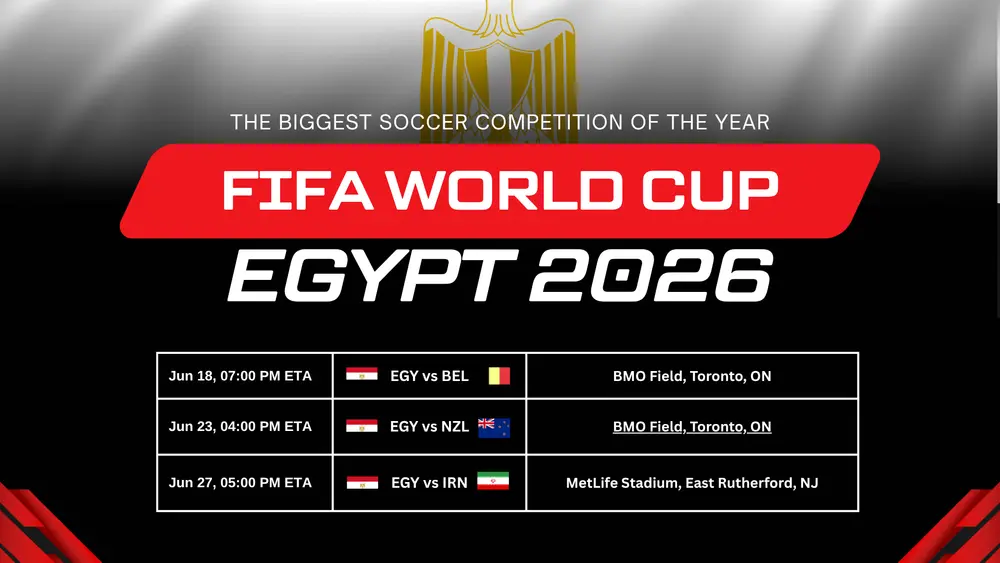
Belgium first in Seattle — Rudi Garcia's side are favoured to top the section. New Zealand in Vancouver is the most winnable fixture, the game Hassan will target for Egypt's first-ever World Cup points. Iran in Seattle to close — the final group game against Iran could prove decisive for a maiden knockout berth.
Salah celebrates his 34th birthday against Belgium. The symmetry is either motivating or loaded with pressure, depending on your disposition.
What Egypt Actually Need to Do
Egypt have never won a World Cup match. Three appearances, three group stage exits. Hassan carries the hopes of a football-obsessed nation into this tournament with a clear mandate — end that record.
Hossam Hassan wants a first-ever knockout run. The New Zealand game is the one Egypt must win — and win comfortably. The Iran game decides everything else. Beat New Zealand, take a point from Iran, and Egypt reach the Round of 32 for the first time in history regardless of the Belgium result.
When Salah and Marmoush are both on form simultaneously, this team is capable of hurting any opponent in the group. The depth behind that pairing also gives Hassan the flexibility to change the tempo and profile of the attack from the bench.
Egypt's 2026 story is ultimately Salah's story. His career has been defined by Liverpool moments. His international legacy remains unwritten. Everything he has built at club level — every goal, every title, every individual award — has been preparation for three games in Seattle and Vancouver.
The Pharaohs are ready. The question is whether the World Cup is ready for Salah.
📋 Download the Full Egypt Squad PDF
All 25 players, clubs, positions and the Group G schedule in one clean printable page.
⬇ Download Egypt 2026 World Cup Squad PDF

Build your own Egypt fantasy squad and compete for USDC prizes at sportsbrackets.net — the world's first crypto-native FIFA World Cup fantasy platform.


