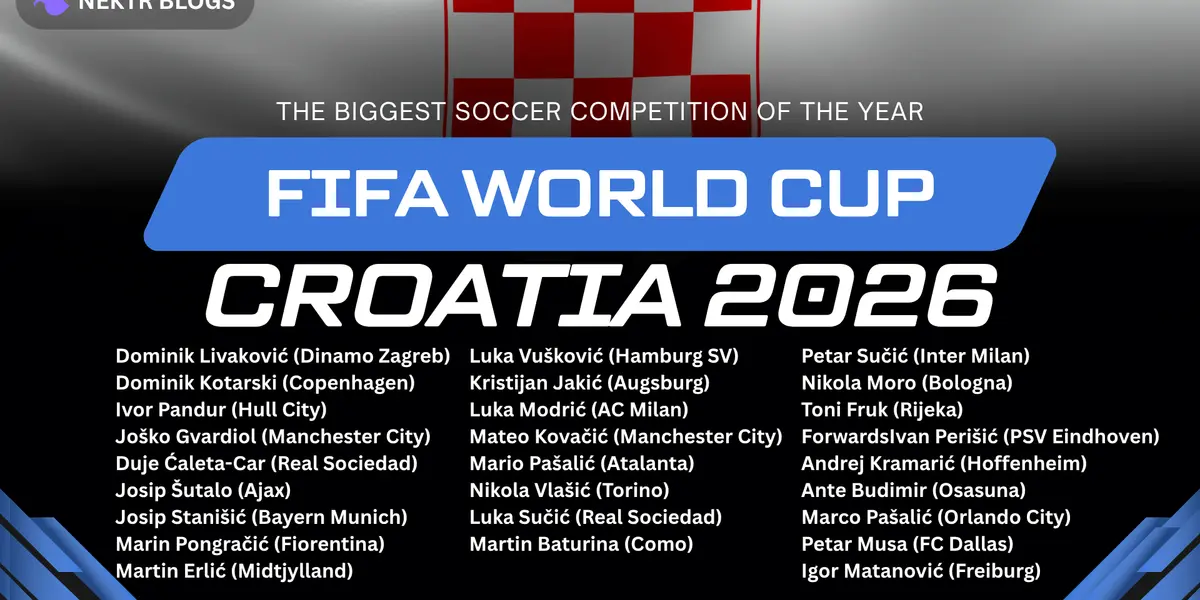
Croatia 2026 World Cup Squad: The Vatreni, a 40-Year-Old Captain, and the End of a Golden Era
In 1998, Croatia finished third at their first World Cup. In 2018, they reached the final. In 2022, they finished third again. No nation in the history of football has been as consistently brilliant at World Cups while being as consistently underestimated before them.
Now comes 2026. Luka Modrić is 40 years old and captaining Croatia for what is almost certainly his final tournament. He has 196 international caps — the most in Croatian history. He has a Ballon d'Or. He has Champions League titles. He has a World Cup final appearance. And he is still good enough to start for a team that coach Zlatko Dalić openly admits is facing "definitely the hardest group" at the tournament.
Group L. England. Ghana. Panama. The opening fixture against England is a rematch of the 2018 semi-final, which Croatia won 2-1 in extra time on the way to the final. That match, at AT&T Stadium in Arlington on June 17, will be one of the most compelling group stage fixtures of the entire tournament.
It will be Croatia's seventh appearance at the FIFA World Cup. Dalić is trying to win a third consecutive medal. The squad is older, the depth is thinner, and the opposition is harder. But this is Croatia. They have been here before.
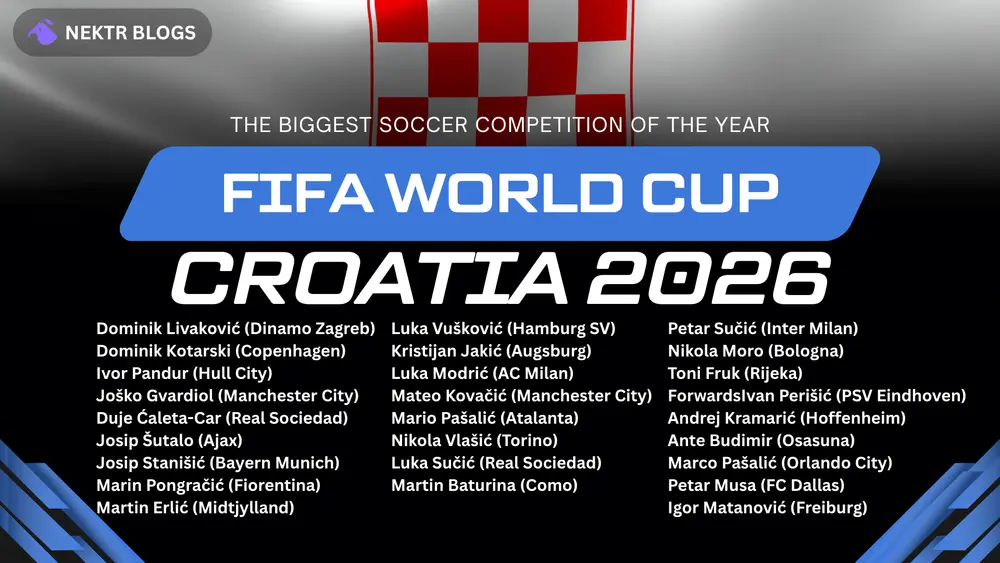
The Coach: Zlatko Dalić
Zlatko Dalić's Croatia career was almost over before it had begun. When he took charge in 2017, he was hired on the provision that if they failed to qualify for the 2018 World Cup, the football association would review his position. They qualified, reached the final, and he became the most successful coach in Croatian football history.
He led Croatia to the 2018 World Cup final, where they lost 4-2 to France, and to a third-place finish at Qatar 2022. The 2026 tournament is his third World Cup in charge.
Dalić said Croatia will start in a 3-4-2-1 formation ahead of the World Cup. "We'll start in a 3-4-2-1 formation, that's my wish and we'll try that. It's a friendly, but the result is important," he said.
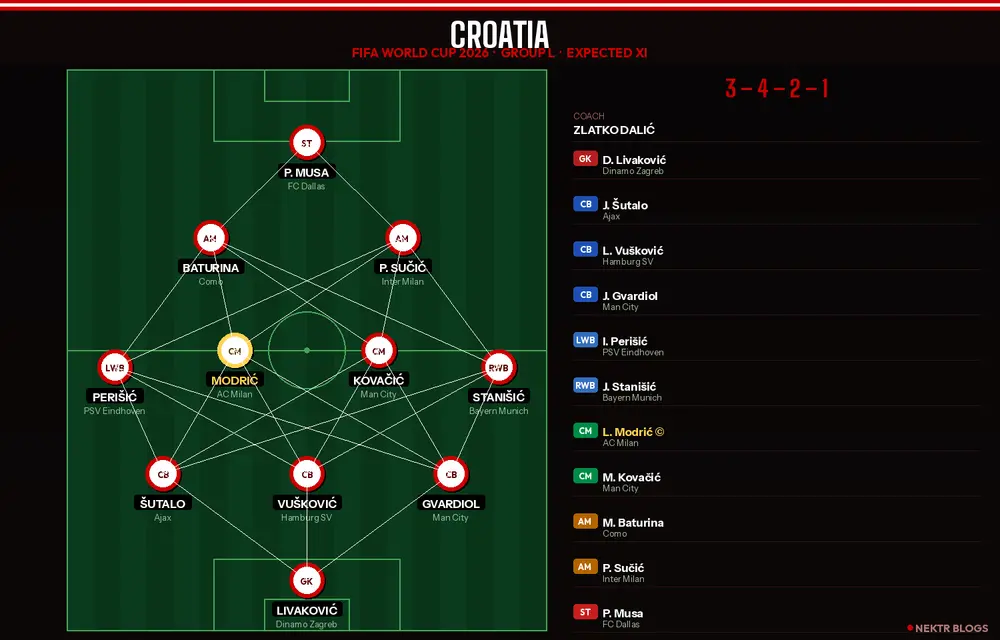
Dalić deployed the 3-4-2-1 formation against Belgium in Croatia's final World Cup warm-up — Dominik Livaković in goal, with Josip Šutalo, Luka Vušković and Joško Gvardiol forming a back three, Josip Stanišić and Ivan Perišić as wing-backs, Luka Modrić and Mateo Kovačić in midfield, Petar Sučić and Martin Baturina in advanced midfield roles behind striker Petar Musa.
The system gives Croatia defensive solidity through the three-centre-back structure while releasing the wing-backs to provide width and the two advanced midfielders to create behind the striker. It is a system that suits the personnel Dalić has available — particularly Gvardiol, who thrives in a back three where he can be aggressive without worrying about the space behind him.
Expected Formation: 3-4-2-1
Modrić and Kovačić control the midfield tempo. Baturina and P. Sučić create ahead of them. Perišić and Stanišić provide the width as wing-backs. Musa leads the press and holds the ball. When Croatia are at their best in this system, they are one of the most difficult teams in the world to break down — and lethal on the transition when they win the ball back.
Goalkeepers
Dominik Livaković — Dinamo Zagreb
Croatia's first-choice goalkeeper and a hero of the 2022 World Cup where he saved three penalties in a shootout against Japan in the Round of 16. Livaković has returned to Dinamo Zagreb after his Fenerbahçe spell and remains the most dependable goalkeeper in the Croatian setup. His shot-stopping and penalty record are exceptional.
Dominik Kotarski — Copenhagen
Developing number two who has performed well in the Danish Superliga. Kotarski's inclusion gives Croatia genuine depth in goal — he is ready to step in if Livaković picks up an injury without the squad suffering a significant drop in quality.
Ivor Pandur — Hull City
Championship-level goalkeeper providing squad depth. Pandur's experience in English football gives him a tactical understanding of the pressing and transition game that Dalić wants to play.
Defenders
Joško Gvardiol — Manchester City
Manchester City pair Joško Gvardiol and Mateo Kovačić have both recovered from injury for this one. Gvardiol is the best defender in this squad and one of the best left-footed centre-backs in the world. At 24 he has already won the Premier League and Champions League with City. In Dalić's 3-4-2-1, he anchors the back three on the left — aggressive, dominant in the air, and composed on the ball. His ability to step forward and drive into midfield from defence adds a dimension that no other Croatian defender can provide.
Josip Šutalo — Ajax
Technical centre-back who has developed significantly at Ajax. Šutalo's composure on the ball and ability to play out from the back suits Dalić's possession-based system. His reading of the game and positioning make him the natural right-sided option in the back three.
Luka Vušković — Hamburg SV
The youngest and most exciting defensive prospect in the squad. Vušković, still a teenager, has been outstanding in the 2. Bundesliga and his inclusion in the World Cup squad is a statement of intent about Croatia's next generation. His physicality and aerial ability give Dalić a dynamic option in the centre of the back three.
Josip Stanišić — Bayern Munich
Right wing-back who has developed into one of the most reliable wide defensive options in German football. Stanišić's ability to both defend and attack from the right flank is essential in the 3-4-2-1 — he needs to cover the entire right channel and deliver into the box when Croatia build forward.
Duje Ćaleta-Car — Real Sociedad
Experienced centre-back with La Liga quality. Ćaleta-Car gives Dalić a reliable defensive option whether in a back three or back four — his versatility is valuable for a squad that may shift systems depending on the opponent.
Marin Pongračić — Fiorentina
Physical and aggressive centre-back who excels in duels. Pongračić's combative style gives Dalić an option when Croatia need a more direct defensive presence — particularly against the physical striker profiles in Group L.
Martin Erlić — Midtjylland
Experienced international who provides depth across the defensive line. Erlić's Danish Superliga experience and composure make him a reliable squad option.
Midfielders
Luka Modrić — AC Milan
The captain. The legend. The 40-year-old man who is somehow still here, still starting, still the best player Croatia have. Modrić's technical quality, vision, and ability to control the tempo of a game remain extraordinary even at his age. The 40-year-old Modrić, widely regarded as one of the greatest midfielders of his generation, remains the centrepiece of the Croatian squad. With 196 international appearances, the former Ballon d'Or winner holds the record for the most caps for Croatia. This is his last World Cup. He will play every minute he possibly can.
Mateo Kovačić — Manchester City
The engine alongside Modrić. Kovačić's energy, pressing intensity, and ability to drive forward from midfield complement Modrić's deep-lying creativity perfectly. His Champions League and Premier League experience at Manchester City has made him one of the most complete midfielders in the game. The Modrić-Kovačić partnership is the best in Croatian football history.
Mario Pašalić — Atalanta
Versatile midfielder who can operate in the advanced midfield roles or as a box-to-box option. Pašalić's goals record from midfield and his ability to arrive late into the penalty area make him a dangerous option in Dalić's 3-4-2-1 when Baturina and Sučić need rotating.
Nikola Vlašić — Torino
Creative and technically gifted attacking midfielder who has been consistently productive in Serie A. Vlašić's ability to find pockets of space between the lines and link the midfield to the attack gives Dalić a different profile in the advanced midfield positions.
Martin Baturina — Como
One of the most exciting young players in Serie A. Baturina's breakout season at Como has drawn comparisons to some of Croatia's great midfield talents. His quick passing, movement, and ability to create in tight spaces make him one of the first names on Dalić's teamsheet in the advanced midfield role. At just 22 he is the future of Croatian football — and he is ready to contribute now.
Petar Sučić — Inter Milan
Technically assured advanced midfielder who has developed rapidly at Inter Milan. Sučić's combination play, positional intelligence, and ability to press aggressively from advanced positions make him the ideal second advanced midfielder alongside Baturina in Dalić's system.
Luka Sučić — Real Sociedad
The other Sučić — no relation. Luka is a different profile from Petar — more dynamic, more direct, capable of taking players on. His La Liga experience gives him the tactical foundation to play in any of the midfield roles Dalić deploys.
Nikola Moro — Bologna
Disciplined central midfielder who gives Dalić a physically imposing option in the middle of the park. Moro's ability to screen the back three and win the ball in the middle third provides genuine depth behind the Modrić-Kovačić partnership.
Kristijan Jakić — Augsburg
Hard-working, reliable central midfielder whose pressing intensity and defensive discipline fit Dalić's system. Jakić gives Croatia the option to become more compact and defensive without losing midfield structure.
Toni Fruk — Rijeka
Young domestic midfielder whose inclusion reflects Dalić's desire to give Croatia's next generation tournament experience. His technical quality in the Rijeka environment has been impressive but the World Cup will be a significant step up.
Forwards
Ivan Perišić — PSV Eindhoven
Ivan Perišić has 196 international appearances and remains a key attacking player in Croatia's setup. At 37, Perišić operates as a left wing-back in Dalić's 3-4-2-1 rather than a pure forward — his experience, crossing ability, and set-piece delivery from the left flank make him one of Croatia's most consistent attacking threats. He scored in the 2018 World Cup final. This is his final tournament.
Andrej Kramarić — Hoffenheim
Established forwards including Andrej Kramarić were considered certain selections. Croatia's most reliable goal scorer in recent years. Kramarić's movement, finishing in tight spaces, and ability to create from deep give Dalić a versatile option who can play as a central striker or in a wide role. His Bundesliga goals record over the past decade is remarkable for someone who never moved to a top-six club.
Ante Budimir — Osasuna
Physical centre-forward whose aerial dominance and hold-up play give Croatia a completely different option to Kramarić's technical game. Ante Budimir was considered a certain selection. Budimir's ability to bring others into play and win aerial duels at set pieces makes him invaluable when Croatia need to change the dynamic of a match.
Petar Musa — FC Dallas
Petar Musa was rewarded for strong recent performances in Major League Soccer. His movement, pressing from the front, and ability to lead the line in Dalić's 3-4-2-1 make him the likely starter. His hold-up play and timing of runs behind defences suit a system designed to release forward runners quickly.
Marco Pašalić — Orlando City
Technical forward whose MLS performances earned him his place in the squad. Marco gives Dalić a different forward profile — more creative, more comfortable with the ball at his feet, capable of linking play between the midfield and attack.
Igor Matanović — Freiburg
Igor Matanović was rewarded for strong recent performances in the Bundesliga. The young striker's development at Freiburg has been rapid and his inclusion gives Croatia a future number nine alongside the experienced options of Kramarić and Budimir.
Croatia's Group L Schedule
Croatia begin their World Cup campaign against England in Dallas on June 17, with their second group match against Panama in Toronto on June 23.
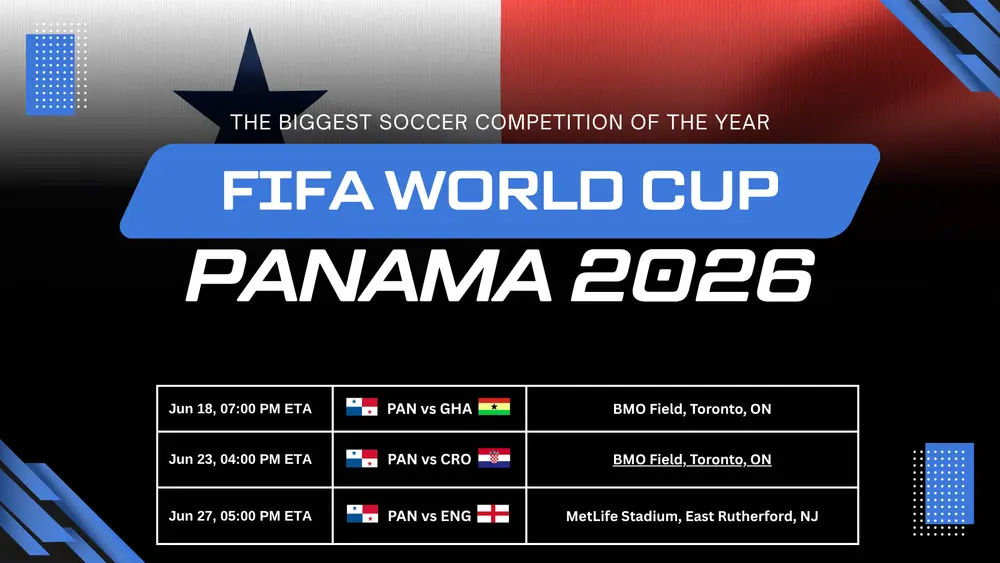
England first in Dallas — the 2018 semi-final rematch. Croatia beat England 2-1 in extra time in Moscow eight years ago. England have not forgotten. Neither have Croatia. Panama in Toronto should be manageable but Christiansen's side are organised and dangerous on the counter. Ghana in Philadelphia to close — a squad with genuine quality that could surprise anyone on their day.
What Croatia Actually Need to Do
Dalić, speaking to RTL, believes Croatia face one of the toughest groups at the tournament. "This is definitely the hardest group," Dalić said. "England vs Croatia will be the strongest match of the entire first round."
Croatia need to beat Panama and Ghana. The England game will likely determine who tops the group. Their experience, tactical intelligence, and the Modrić-Kovačić midfield give them every chance against both Ghana and Panama regardless of how the England result goes.
The bigger question is what happens in the knockout stages. The 2018 run was built on three consecutive extra-time victories — sheer willpower and defensive resilience carrying a technically gifted team past expectations. This squad is older and the depth is thinner. But Dalić has done this before. And as long as Modrić is on the pitch, Croatia are never just making up the numbers.
Third consecutive World Cup medal. It seems impossible. Croatia will try anyway.
📋 Download the Full Croatia Squad PDF
All 26 players, clubs, positions and the Group L schedule in one clean printable page.
⬇ Download Croatia 2026 World Cup Squad PDF

Build your own Croatia fantasy squad and compete for USDC prizes at fantasy.sportsbrackets.net — the world's first crypto-native FIFA World Cup fantasy platform.


