Panama 2026 World Cup Squad: Los Canaleros, the Coach Who Built a Nation, and a Group Nobody Wants to Be the Underdog In
Panama went to the 2018 World Cup and came back without a point. They lost to Belgium, England, and Tunisia. They scored two goals — their first two in World Cup history — but finished bottom of the group and went home.
Eight years later they are back. This time they qualified on merit through one of the most impressive CONCACAF qualifying campaigns in recent memory — unbeaten in the second group stage, topping CONCACAF Group A, with a record that put them above more historically prominent nations in the confederation.
The coach is the same man who built all of it. Thomas Christiansen has been in charge since the summer of 2020. Under his guidance, Panama reached the final of the 2023 CONCACAF Gold Cup, progressed to the quarter-finals of the 2024 Copa America, contested the 2025 CONCACAF Nations League final, and secured qualification for the 2026 World Cup without suffering a single defeat.
"We want to make history, we want to do something beautiful and improve on what we did before," Christiansen said during the squad presentation at the Administration Building of the Panama Canal.
The group is Group L. England, Croatia and Ghana. England are ranked 4th in the world, Croatia 10th, Panama 30th. Panama are the underdogs. They have been the underdogs at every step of this journey. They qualified anyway.
The Coach: Thomas Christiansen
Christiansen was born in Hadsund, Denmark on March 11, 1973, but grew up in Spain and played his entire career there, including time at Barcelona. He earned two international caps for Spain in 1993. He was appointed Panama coach on July 23, 2020, making it his first senior international role. He managed AEK Larnaca and APOEL Nicosia in Cyprus, winning the domestic title with APOEL in 2017, then took charge of Leeds United and Union Saint-Gilloise in Belgium. With Panama he has set the national record for most international matches managed.
Panama usually operate in either a 3-4-3 or a flexible 4-2-3-1, with the wingbacks playing a huge role in transitions. The midfield is also aggressive without the ball. Panama press physically and try to disrupt rhythm rather than just absorb.
Christiansen trusts chemistry and experience more than big gambles. The squad he named for this tournament reflects that philosophy exactly — veterans rewarded for loyalty, younger players who proved themselves through qualifying, and a captain with more international caps than almost anyone alive.
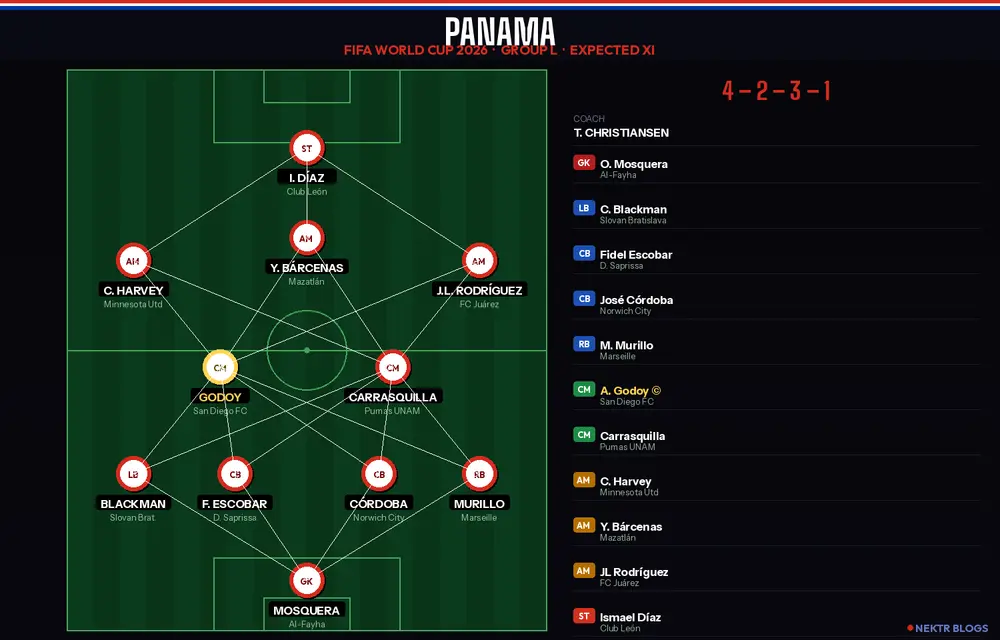
Expected Formation: 4-2-3-1
Compact shape defensively. Godoy as the anchor. Carrasquilla as the dynamic partner driving forward. Wide players asked to press and recover. Ismael Díaz linking everything from the number ten position. Waterman available as a physical alternative to Díaz when Panama need to go direct.
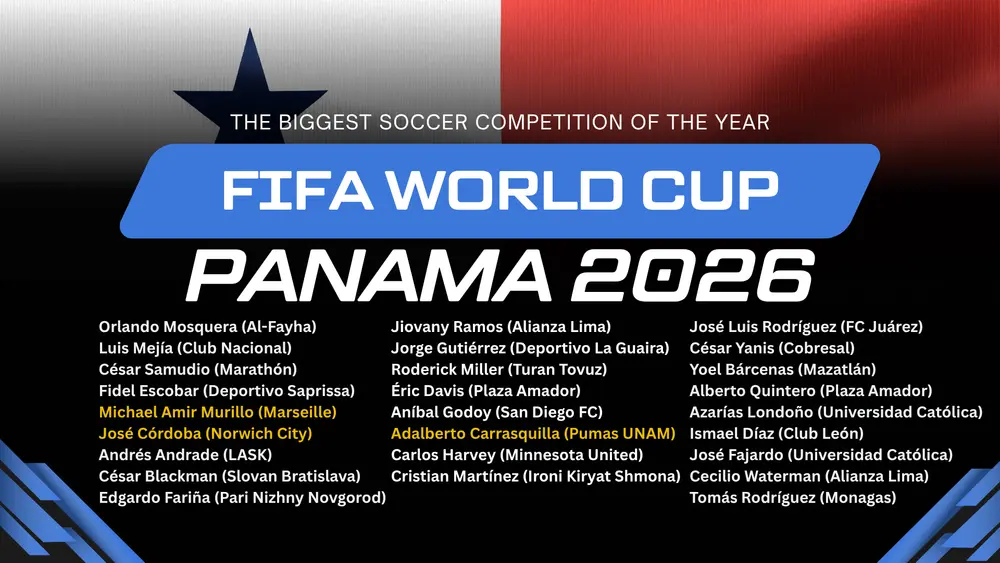
Goalkeepers
Orlando Mosquera — Al-Fayha
The most experienced goalkeeper in the squad and Christiansen's first choice. Mosquera brings composure under pressure and a vocal presence that organises the back line. His experience playing in Saudi Arabia's Pro League against high-quality opposition has sharpened his ability to face forward pressure.
Luis Mejía — Club Nacional
The veteran backup. Mejía has been part of Panama's setup for over a decade and provides the squad with a calming voice of experience behind Mosquera. His knowledge of Christiansen's system is invaluable in the preparation phase.
César Samudio — Marathón
Third-choice keeper with solid domestic credentials. His role is depth and competition, ensuring the starting position remains contested throughout preparation.
Defenders
Michael Murillo — Marseille
The most technically accomplished defender in the squad. Murillo has been one of the best right backs in Ligue 1 over the past two seasons, earning recognition well beyond CONCACAF. His combination of pace, positioning, and attacking quality from deep gives Panama an outlet on the right flank that no other player in the squad can match.
José Córdoba — Norwich City
One of the most promising centre-backs in CONCACAF. Córdoba's physicality, aerial dominance, and composure on the ball have caught the attention of clubs beyond Central America. His partnership with the veteran Fidel Escobar gives Panama's back line a balance of youth and experience.
Fidel Escobar — Deportivo Saprissa
The defensive leader alongside Córdoba. Escobar's experience, reading of the game, and leadership on the pitch have been central to Panama's defensive organisation under Christiansen. His positioning and ability to manage physical strikers make him essential in a group that includes the physical threat of England and Croatia's technical forwards.
César Blackman — Slovan Bratislava
Left back who has developed significantly under Christiansen's system. Blackman's defensive discipline and recovery pace give Panama a reliable option on the left side of a back four. His partnership with Murillo on the opposite flank creates natural width.
Edgardo Fariña — Pari Nizhny Novgorod
Physical and defensively minded central option who gives Christiansen flexibility to shift into a back three when protecting a lead. His aerial ability from set pieces adds an attacking dimension at dead-ball situations.
Jiovany Ramos — Alianza Lima
Experienced right-sided defender who has been part of the Panama setup for several years. His understanding of Christiansen's positional demands makes him a reliable rotation option.
Jorge Gutiérrez — Deportivo La Guaira
Versatile defensive option capable of playing in multiple positions across the back line. His adaptability gives Christiansen tactical flexibility in how Panama set up against different opponents.
Roderick Miller — Turan Tovuz
Veteran of international football with over 100 caps. Miller brings experience and leadership beyond what his current club level suggests — a trusted option in the squad environment.
Midfielders
Aníbal Godoy — San Diego FC
Captain Aníbal Godoy has played for Panama 159 times. One of the most capped players in CONCACAF history. At 35, Godoy is no longer the box-to-box powerhouse he once was, but his reading of the game, positioning, and calm in the double pivot protect the back four in a way that no younger player in this squad can replicate. His leadership on and off the pitch is the backbone of Christiansen's entire system.
Adalberto Carrasquilla — Pumas UNAM
The most technically gifted midfielder in the squad. Carrasquilla was included despite suffering an injury in the Liga MX final defeat to Cruz Azul. His ability to drive forward from midfield, play through pressure, and arrive in the penalty area from deep gives Panama a dynamic dimension that Godoy's anchor role enables. When Carrasquilla is fit and firing, Panama are a different team.
Carlos Harvey — Minnesota United
Young, energetic, and one of the players who has flourished most under Christiansen's setup. Harvey's pressing intensity, quick passing, and ability to cover ground in the wide midfield position make him one of the most important players in how Panama's system functions.
Yoel Bárcenas — Mazatlán
Wide midfielder with pace and directness. Bárcenas has experience at Liga MX level and brings a different threat on the flank — willing to run at defenders and create chances from wide positions.
José Luis Rodríguez — FC Juárez
Technically assured wide option who can operate on either flank. Rodríguez's composure on the ball and ability to combine in tight spaces give Christiansen a creative alternative when Panama need to build through possession rather than press and transition.
Éric Davis — Plaza Amador
35-year-old Éric Davis is another 100-cap man and was the only member of Christiansen's squad who plays in Panama. His experience, leadership and understanding of Christiansen's system have made him indispensable to the squad setup despite his age and domestic league level.
Alberto Quintero — Plaza Amador
Veteran forward Alberto Quintero was named in the squad after missing the 2018 World Cup through injury. At 35, his inclusion at last gives him the World Cup he was denied eight years ago. A moment of genuine sporting justice in the squad announcement.
Christian Martínez — Ironi Kiryat Shmona
Technical midfielder who has developed his game in the Israeli Premier League. His positioning and ball-playing quality give Christiansen a composed option in the centre of midfield when Panama need control rather than press.
Forwards
Ismael Díaz — Club León
The most important attacking player in the squad. Díaz's movement, technical quality, and ability to link play between midfield and attack make him the creative focal point of everything Panama try to do offensively. His instinctive runs in behind defenders, combined with the clinical finishing that has developed in his time in Mexico, make him the player opponents must account for from the first minute.
Cecilio Waterman — Alianza Lima
The physical alternative. Cecilio Waterman remains a key figure in Panama's attack. His strength, hold-up play, and aerial threat give Christiansen a completely different option when Panama need to play more directly — essential in the closing stages of tight matches when space opens and physical duels become more decisive.
José Fajardo — Universidad Católica
Experienced international forward with a consistent goals record across Latin American football. José Fajardo is one of Panama's top goal-scoring threats. His movement, positioning, and the ability to score from limited chances make him a dangerous option off the bench.
César Yanis — Cobresal
Creative forward who can operate in the number ten position or wide. Yanis's flair and ability to find pockets of space give Panama an unpredictable element when Christiansen wants to change the game's dynamic.
Azarias Londoño — Universidad Católica
Physical forward option with South American league experience. Londoño's directness and ability to run at defenders make him a useful option when Panama are chasing a game.
Tomás Rodríguez — Monagas
Young forward developing in Venezuelan football. His inclusion signals Christiansen's thinking about the next generation even as this squad prioritises experience.
Panama's Group L Schedule: The Toughest Draw They Could Have Got
Panama are in Group L alongside England, Croatia and Ghana. Three games across Toronto, Boston and New Jersey.
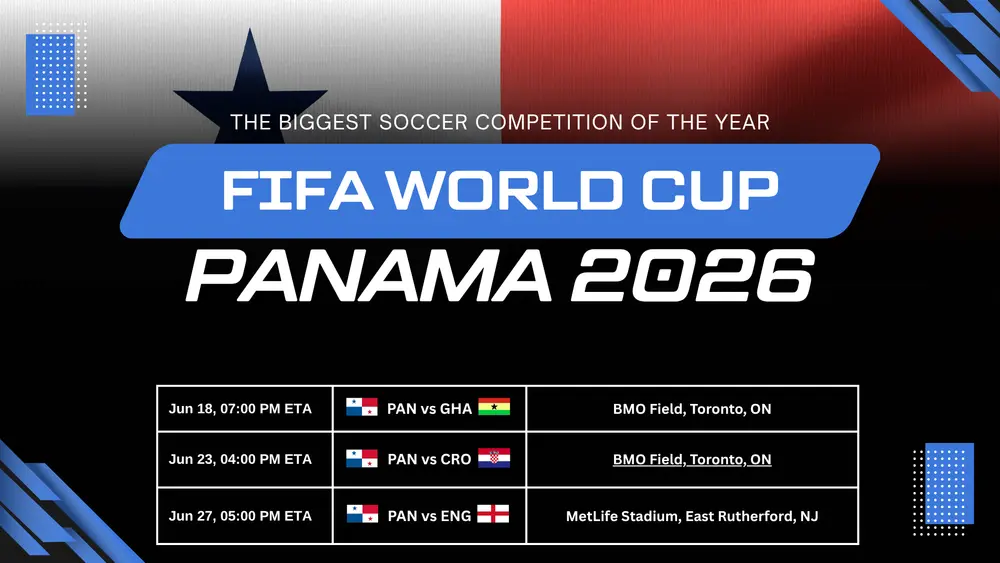
Panama's final group game on June 27 is against England at MetLife Stadium in East Rutherford — the same England side that beat Panama 6-1 at the 2018 World Cup. Panama will not have forgotten that.
The real targets are the Ghana opener in Toronto and the Croatia game on June 23, also in Toronto. Two games in the same city, at the same stadium. Ghana are the most beatable team in the group. Croatia are experienced but ageing. England, ranked fourth in the world under Thomas Tuchel, are the team Panama will likely concede against — but also the team they will want to show the world they are no longer the same side from 2018.
The Ghana game in Toronto is the match that defines Panama's tournament.
What Panama Actually Need to Do
Panama have never taken a point at a World Cup. That changes in 2026 or it doesn't, and a generation of players who have built something genuinely impressive under Christiansen's six years of work will leave North America without a result to show for it.
Christiansen will target a historic result in Panama's opening World Cup fixture against Ghana as he looks to secure Panama's first-ever point — or even points — on the global stage.
Ghana are beatable. Panama have the defensive organisation, the midfield press, and the attacking quality of Ismael Díaz to cause problems. If Carrasquilla recovers full fitness from his injury, the midfield becomes even more dangerous.
The Panama Canal. The national record. 159 caps for Godoy. Quintero's delayed World Cup. A coach who has spent six years building this exact moment.
One result. That's all they need to make history.
📋 Download the Full Panama Squad PDF
All 26 players, clubs, positions and the Group L schedule in one clean printable page.
⬇ Download Panama 2026 World Cup Squad PDF

Build your own Panama fantasy squad and compete for USDC prizes at fantasy.sportsbrackets.net — the world's first crypto-native FIFA World Cup fantasy platform.


