
Qatar 2026 World Cup Squad: The Maroons, A Sacked Coach's Redemption Story, and the Weight of 2022
In 2022, Qatar became the first host nation in World Cup history to lose all three group games. They conceded nine goals. The country absorbed the result at home, in front of their own fans, and the football federation immediately began rebuilding for 2026.
What changed is significant. This time Qatar have qualified on merit — their first-ever World Cup qualification through the competitive route after three successful rounds of AFC qualifiers. The two-time reigning Asian champions arrive in North America as genuine qualifiers, not courtesy guests.
The coach they appointed is one of football's great what-if stories. Julen Lopetegui was sacked as Spain manager the day before the 2018 World Cup began after accepting the Real Madrid job without informing the federation. He never got his chance. Now, eight years later, he finally gets to stand on the touchline at a World Cup — but with Qatar rather than Spain.
The group is Group B. Canada, Bosnia and Herzegovina, and Switzerland complete the quartet. On paper it is manageable. In practice, Lopetegui's record since taking charge has been deeply unconvincing — two wins from eleven matches — and Qatar conceded heavily throughout. The talent is there. The system is not yet working.
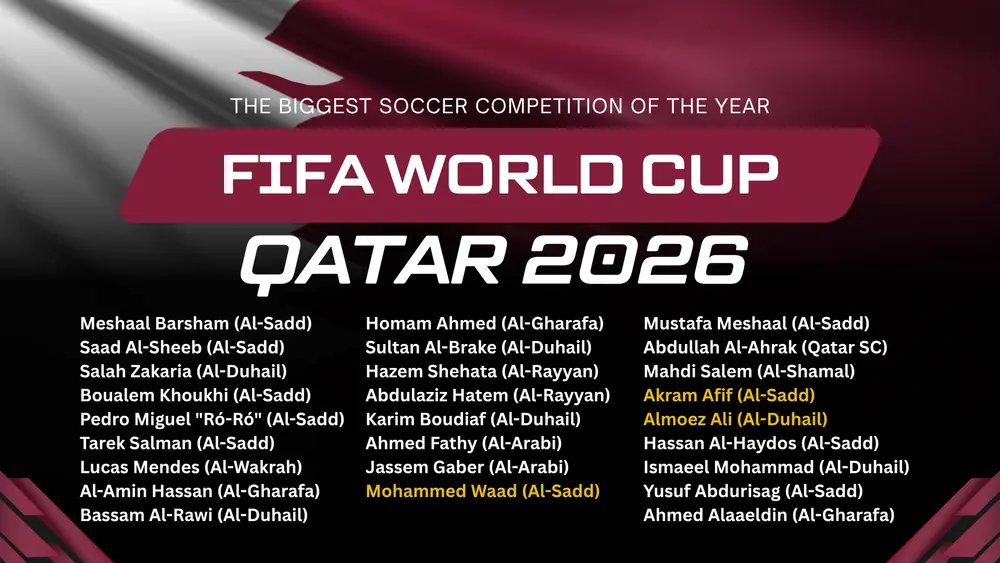
Here is the full squad, what to expect, and why Akram Afif might be the most underrated player at this tournament.
The Coach: Julen Lopetegui
Lopetegui was appointed Qatar's head coach in May 2025, replacing Marquez Lopez who departed in December 2024. The Spanish manager brings established European coaching pedigree — spells at Sevilla winning the UEFA Europa League, Real Madrid, Wolverhampton Wanderers, and the Spanish national team.
His record since taking charge has been poor — two wins from eleven matches and a group stage exit at the Arab Cup. But Lopetegui's systems take time to embed, and his best work at Sevilla showed a coach capable of building a tactically disciplined, defensively compact side that punches above its weight in elimination football.
The predicted lineup reflects the best available combination of defensive organisation, midfield control, and attacking quality around Afif and Almoez Ali.
Qatar's approach is built on controlled possession and disciplined defensive organisation — staying compact, protecting central areas, and releasing the ball quickly into Afif when space appears.
Expected Formation: 4-2-3-1
The 4-2-3-1 structure supports both defensive organisation and attacking flexibility. Two holding midfielders maintain control in central areas while advanced players operate between defensive lines — compact spacing and positional discipline during high-pressure phases. Afif operates as the free number ten, dropping to receive and driving at defenders when space opens.
Goalkeepers
Meshaal Barsham — Al-Sadd
Barsham is the first-choice goalkeeper Lopetegui has settled on. Athletic, commanding in the air, and vocal in organising the defensive line. His experience in the AFC Asian Cup winning campaigns gives him the composure for high-pressure moments. The only question is whether his distribution can support Lopetegui's desire to build quickly from the back.
Saad Al-Sheeb — Al-Sadd
The previous number one from Qatar 2022, now stepping into the backup role. Al-Sheeb brings World Cup experience that no other goalkeeper in this squad has — valuable as a voice in the dressing room even when he is not playing.
Salah Zakaria — Al-Duhail
Third-choice keeper with solid domestic credentials. His role is to provide depth and maintain the competitive environment in training.
Defenders
Boualem Khoukhi — Al-Sadd
The defensive leader and one of the most experienced players in the squad. Khoukhi has over 100 international caps, captained Qatar to their 2019 and 2023 AFC Asian Cup titles, and brings composure and reading of the game that the younger defenders around him can learn from.
Lucas Mendes — Al-Wakrah
Brazilian-born but Qatari by nationality since 2017. A consistent, reliable centre-back whose partnership with Khoukhi has been the defensive bedrock of this squad for several years. His positioning and aerial ability make him effective against physical strikers.
Sultan Al-Brake — Al-Duhail
Powerful right back with experience across multiple AFC qualifying campaigns. Physical, difficult to get past, and effective in aerial duels. His discipline in the wide defensive position is essential to Lopetegui's compact defensive shape.
Homam Ahmed — Al-Gharafa
Left back with energy and the ability to support attacks without abandoning his defensive post. His understanding of Lopetegui's positional demands has developed through the qualifying campaign.
Bassam Al-Rawi — Al-Duhail
Experienced defensive option who can operate at centre-back or right back. His domestic form earned him a place in the final 26 and gives Lopetegui flexibility in how the back line is set up.
Al-Amin Hassan — Al-Gharafa
Young and athletic, Al-Amin's pace and recovery speed make him a useful backup option in the wide defensive positions.
Tarek Salman — Al-Sadd
Reliable domestic defender who adds depth to a squad that is not overloaded with defensive options beyond the first-choice pairing.
Ró-Ró — Al-Sadd
Veteran Brazilian-born defender who has become one of the most consistent performers in Qatar's domestic league. His experience and composure under pressure make him a trusted option in Lopetegui's defensive rotation.
Midfielders
Karim Boudiaf — Al-Duhail
The midfield anchor. Boudiaf has been at the heart of Qatar's most successful period as a football nation — both Asian Cup titles, and the 2022 World Cup squad. His screening of the back four, ball-winning ability, and experience in high-pressure moments make him the most important defensive midfielder in the squad.
Mohammed Waad — Al-Sadd
Dynamic box-to-box midfielder who provides the energy and running that allows Boudiaf to stay disciplined positionally. Waad's pressing from the middle third is central to how Qatar win the ball back when they lose possession.
Hazem Shehata — Al-Rayyan
Technical midfielder who can operate centrally or in the wider areas of a midfield three. His ability to keep the ball under pressure and transition between phases gives Lopetegui a composed option when Qatar need to slow the game down.
Abdulaziz Hatem — Al-Rayyan
Experienced international who provides the squad with depth and leadership from the bench. At 35 he is no longer the starter he once was, but his understanding of Lopetegui's system and his presence in the dressing room remain valuable.
Jassem Gaber — Al-Arabi
Wide midfielder capable of contributing at both ends of the pitch. His directness and ability to stretch defences give Qatar a different dimension when Afif drifts inside.
Mustafa Meshaal — Al-Sadd
Young central option developing rapidly in the Qatari system. His inclusion reflects the federation's commitment to building continuity beyond the 2026 tournament.
Abdullah Al-Ahrak — Qatar SC
Energetic wide midfielder who tracks back diligently and contributes defensively as much as offensively. His work rate fits Lopetegui's pressing demands.
Mahdi Salem — Al-Shamal
The youngest midfielder in the squad. Salem's technical quality and composure on the ball have impressed at domestic level. Tournament experience at 21 is the primary objective.
Forwards
Akram Afif — Al-Sadd
The best player Qatar has ever produced. Afif won the 2023 AFC Asian Player of the Year award, scored a hat-trick in the Asian Cup final to win the tournament, and is the creative engine around whom Lopetegui has built the entire attacking system. His ability to drop into pockets, drive at defenders, and deliver in the final third is unique in this squad. Qatar's ceiling at this tournament is determined almost entirely by how well Afif performs.
Almoez Ali — Al-Duhail
Qatar's all-time leading scorer. Ali's movement, hold-up play, and ability to finish in tight situations make him the ideal partner for Afif's creativity. He scored in every group game at the 2019 Asian Cup on the way to the title. At 29, this is his best and perhaps last chance to show what he can do at a World Cup.
Hassan Al-Haydos — Al-Sadd
The team captain with over 180 international caps — one of the most capped players in Asia. At 34 Al-Haydos brings experience, leadership, and the kind of big-game mentality that only comes from having played in hundreds of high-pressure matches. His days as a regular starter are behind him, but as an impact substitute he remains significant.
Yusuf Abdurisag — Al-Sadd
Fast, direct winger who can change a game in twenty minutes from the bench. His pace and willingness to run in behind tired defenders give Lopetegui a dangerous option late in matches when space opens up.
Ismaeel Mohammad — Al-Duhail
Physical striker option who gives Qatar a completely different profile from the more technical Almoez Ali. Useful when Lopetegui needs to play more directly or protect a lead.
Ahmed Alaaeldin — Al-Gharafa
Young forward whose form for Al-Gharafa earned him his first senior call-up. His inclusion is about the future as much as this tournament — Lopetegui wants him in the environment.
Qatar's Group B Schedule
Qatar's three group-stage games are: June 13 vs Switzerland at Levi's Stadium, San Francisco Bay Area; June 18 vs Canada at BC Place, Vancouver; and June 24 vs Bosnia and Herzegovina at Lumen Field, Seattle.
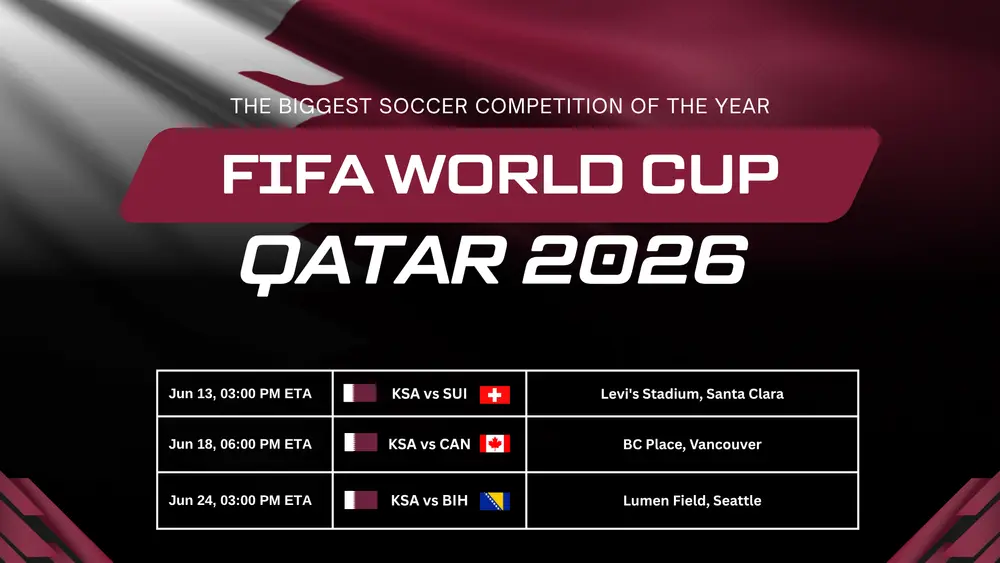
Switzerland first — a tough opener against a technically superior team. Canada in Vancouver is the hardest fixture — co-hosts playing at home in front of 54,000. Bosnia in Seattle in the final group game is the one Qatar will likely need to target for a result — accepting that the group will probably require getting something there in a must-win scenario.
What Qatar Actually Need to Do
Qatar are the group's weakest side and realistically face an uphill task to reach the round of 32. The three teams with them in the group are all superior on paper. However, they cannot be entirely dismissed — Afif and Almoez Ali are legitimate threats, and Lopetegui's tactical nous gives them a marginal edge over sides that have underestimated their structure before. A third-place finish with a potential route to the knockout rounds as one of the top eight third-placed teams is the best realistic outcome.
The memory of 2022 is motivation. The fact that they qualified on merit this time is belief. Afif is the best player in Asian football. Lopetegui finally has his World Cup.
If Qatar's defensive shape holds, and Afif fires, one result in this group is absolutely possible.
📋 Download the Full Qatar Squad PDF
All 26 players, clubs, positions and the Group B schedule in one clean printable page.
⬇ Download Qatar 2026 World Cup Squad PDF

Build your own Qatar fantasy squad and compete for USDC prizes at fantasy.sportsbrackets.net — the world's first crypto-native FIFA World Cup fantasy platform.


