
Canada's 2026 World Cup Squad: The Home Tournament, the Pressure, and Whether This Generation Can Finally Win a Match
Canada has played six men's World Cup games in their entire history. They have won zero of them.
That record ends in 2026 — or it doesn't, and the most talented Canadian generation ever will be remembered for squandering the best opportunity the country has ever had. Playing at home, in front of packed crowds in Toronto and Vancouver, with Alphonso Davies fit, Jonathan David at Juventus, and a squad deeper than anything Canada has previously assembled.
Coach Jesse Marsch knows exactly what's at stake. Here's who made the 26, how they line up, and what Canada actually needs to do to advance.
The Coach: Jesse Marsch
Marsch is an American who has fully committed to the Canadian project. Hired in May 2024, his contract runs through the end of the 2026 World Cup — he was brought in specifically to build this squad for this tournament, not as a stopgap.
His identity as a coach is clear: high press, vertical transitions, relentless intensity. He built his reputation at Red Bull Salzburg, RB Leipzig, and the New York Red Bulls running the same system. At those clubs it worked because the players bought in physically and tactically from day one. Canada's squad has the athleticism for it. The question is whether that energy can sustain across multiple knockout matches if they get there.
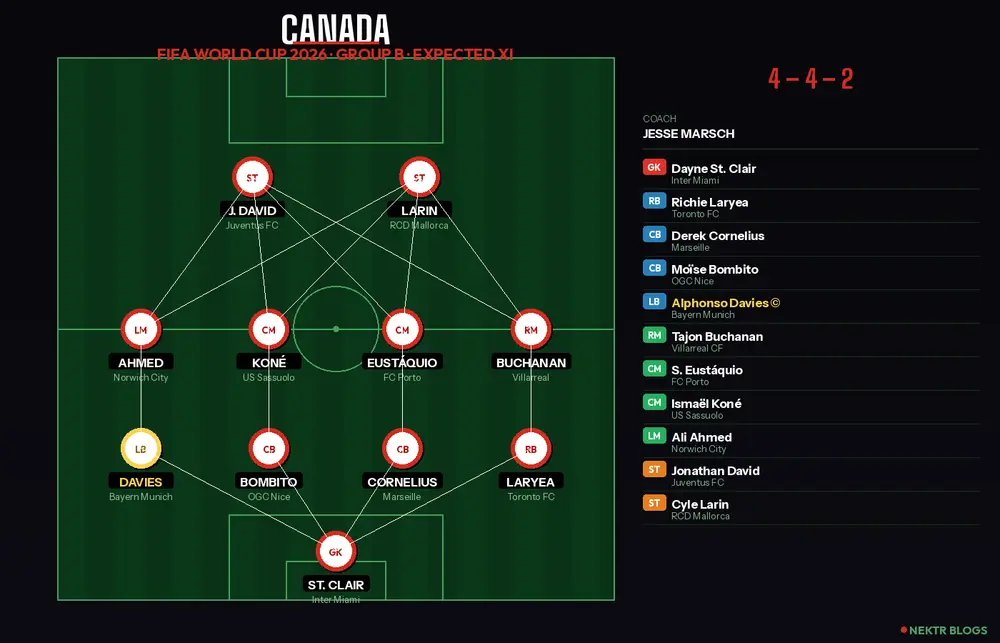
Marsch's 4-4-2 system focuses on rapid transitions in attack and a compact defensive shape when out of possession, anchored by a double pivot midfield. He has spoken openly about targeting four points in the group stage as the baseline for success, with winning Group B not out of the question given the draw.

Goalkeepers
Dayne St. Clair — Inter Miami FC
St. Clair has been among the best goalkeepers in MLS and has the inside track on being the starting goalkeeper to open the World Cup. His distribution fits Marsch's system — Canada want to play out quickly from the back. Commanding in the air, good with his feet.
Maxime Crépeau — Orlando City SC
The incumbent from Qatar 2022. His experience at a World Cup gives him an edge in the squad even without the starting shirt. Reliable and professional, exactly what you need from a backup goalkeeper in a tournament environment.
Owen Goodman — Crystal Palace FC
The youngest of the three. A Crystal Palace academy product who has impressed enough to make the cut. Won't play unless injuries force the issue, but his inclusion speaks to how seriously Canada is taking squad depth.
Defenders
Alphonso Davies — Bayern Munich
The most important player in this squad who isn't a striker. Davies doesn't play like a left back — he plays like a left winger who happens to start thirty metres deeper. His acceleration, dribbling and crossing are generational. Should he be healthy, expect him to play every minute. His ACL recovery earlier this year made his inclusion uncertain; his fitness heading into the tournament is the single biggest variable for Canada's ceiling.
Moïse Bombito — OGC Nice
One of the most improved defenders in Ligue 1. Bombito's ability on the ball, aerial dominance, and composure under pressure have made him Canada's best centre-back option when fit. His recovery from a leg injury is the other major fitness concern in this squad.
Derek Cornelius — Olympique de Marseille
The defensive leader. Cornelius brings experience, physicality, and consistent performances in Ligue 1 that put him above any other Canadian centre-back in terms of club pedigree. Cornelius has been fantastic and sets the tone with a stern presence.
Alistair Johnston — Celtic FC
One of the most versatile defenders in the squad. Johnston can play right back or centre-back, has won back-to-back Scottish Premiership titles with Celtic, and consistently performs at the top of his game for Canada. His understanding with Davies down the left opens space for him to attack from the right.
Richie Laryea — Toronto FC
The hometown right back playing the home tournament. Laryea's energy, dribbling in tight spaces, and crossing ability make him a constant threat going forward. Marsch has publicly praised his performances throughout qualifying. One of the players who makes this 4-4-2 work by being able to get to the byline.
Luc de Fougerolles — Fulham FC
The youngest centre-back option in the squad. De Fougerolles brings Premier League club experience and a composure on the ball that belies his age. Likely fifth-choice at centre-back, but his inclusion shows the depth Canada now have in defence.
Joel Waterman — Chicago Fire FC
Qatar 2022 veteran. Waterman's experience in a World Cup environment makes him valuable beyond his club form. Steady, reliable, knows what's expected. The kind of player every squad needs.
Alfie Jones — Middlesbrough FC
Recovered from an ankle injury to make the cut. Physical, good in the air, disciplined positionally. Gives Marsch another option at centre-back if Bombito or Cornelius pick up knocks.
Niko Sigur — Hajduk Split
A versatile option at full-back who can cover both flanks. His experience in the Croatian top flight and ability to adapt tactically gives Marsch flexibility in how he lines up.
Midfielders
Stephen Eustáquio — FC Porto
The most complete midfielder in Canada's squad. Eustáquio has been outstanding for Porto in the Champions League and brings technical quality, defensive discipline, and leadership to the double pivot. His ability to win the ball, recycle possession under pressure, and occasionally arrive late into the box makes him Canada's most important outfield player outside the forwards.
Ismaël Koné — US Sassuolo
At 23, Koné is already one of the best box-to-box midfielders in Serie A. His energy, athleticism, and ability to cover ground make him the ideal partner for Eustáquio. Together they form the defensive shield that allows Davies and Laryea to get forward. The way this midfield functions determines how far Canada go.
Tajon Buchanan — Villarreal CF
One of the most dangerous wide players in the squad. His pace, dribbling, and ability to combine on the right side with Johnston give Canada a consistent threat in wide areas. His move to Villarreal has sharpened his game in tight European football.
Ali Ahmed — Norwich City FC
A technically intelligent wide midfielder who provides an alternative to Buchanan's directness. Ahmed's short combination play in tight spaces suits a system that wants to recycle quickly and press from high up. Marsch values his positioning and movement.
Mathieu Choinière — LAFC
A different profile on the left — Choinière is more of a runner than a dribbler, thriving in the channels and pressing from wide positions. His move to LAFC has given him regular minutes and consistent form heading into the tournament.
Jonathan Osorio — Toronto FC
The most experienced midfielder in the squad. Osorio has been a fixture for Canada since 2013 and brings a calmness and reading of the game that none of the younger options can match. At 33 he won't start every game, but his ability to manage a match when Canada need to see out a result is invaluable off the bench.
Nathan Saliba — RSC Anderlecht
Young, technically gifted, and developing quickly at one of Belgium's top clubs. Saliba is a depth option who could feature in rotation if the group stage fixtures allow for it.
Marcelo Flores — Tigres UANL
The most creative option in midfield when Canada need something different. Flores is comfortable in tight spaces and can play through the lines — a useful option when the high press isn't working and Canada need someone to unlock a defence through technical play rather than pace.
Jacob Shaffelburg — LAFC
Wide midfielder with directness and work rate. His pressing and ability to get at defenders make him a useful option from the bench when Canada need to change the tempo of a match.
Forwards
Jonathan David — Juventus FC
The best Canadian footballer alive who isn't named Alphonso Davies. David's move to Juventus confirmed what Ligue 1 watchers already knew: he is a world-class finisher. His movement, hold-up play, and ability to score in any situation — one-on-one, headers, volleys, cutbacks — make him Canada's most reliable source of goals. Marsch has described him as the best forward he has ever coached.
Cyle Larin — RCD Mallorca
The physical presence David needs alongside him. Larin holds the ball, occupies centre-backs, and creates space that David exploits. His experience in La Liga and his goals record for Canada make him the natural starting striker partner in the 4-4-2. Big tournament player who scores in important moments.
Tani Oluwaseyi — Villarreal CF
The squad's most exciting attacking option off the bench. Oluwaseyi's pace and directness in one-on-one situations can change a game in fifteen minutes. His Villarreal move has given him exposure to high-level tactical defending — he knows how to beat it.
Liam Millar — Hull City FC
Versatile attacker who can play wide or through the middle. Millar's technical quality and ability to operate in tight spaces give Marsch a different option when Canada want to keep possession and work through a defence rather than go direct.
Promise David — Royale Union Saint-Gilloise
The squad's unknown quantity up front. Promise David has been extraordinary in the Belgian top flight and his inclusion reflects how seriously Canada are taking depth in the attacking line. His movement and finishing in the final third give Marsch a genuine alternative.
Expected Formation: 4-4-2
Davies operates as a left back who attacks like a winger. Buchanan mirrors him on the right. The double pivot of Eustáquio and Koné does the defensive work. Jonathan David and Cyle Larin press in tandem up front. It's a system that rewards pace, pressing, and quick vertical balls — and Canada have all three.
Canada's Group B Schedule: Playing at Home
Canada play all three group games on home soil — one of the genuine advantages of co-hosting.
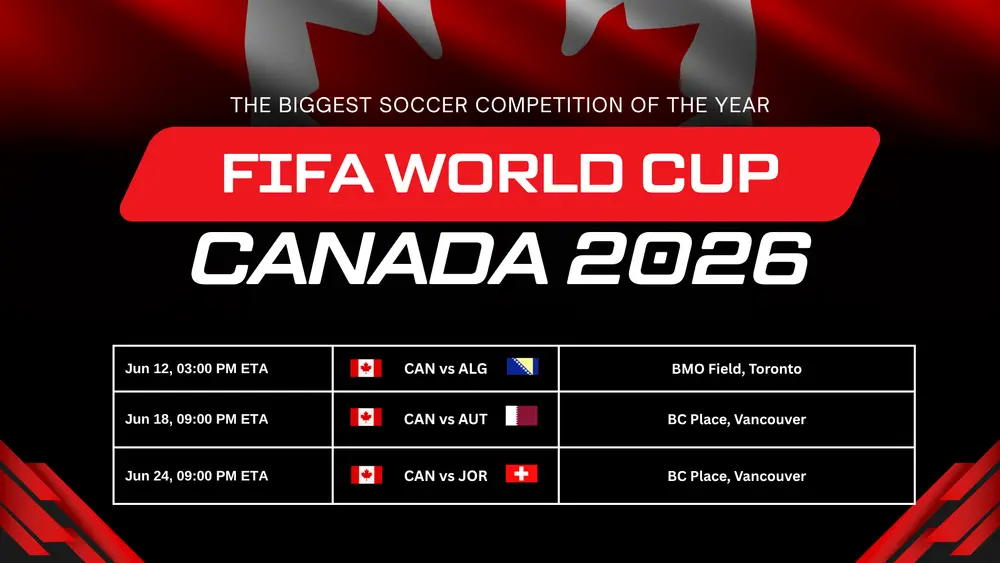
Canada opens tournament play in Toronto before heading west to Vancouver. Bosnia and Herzegovina and Qatar are beatable. Switzerland is the hardest test — experienced, technically disciplined, and dangerous on the counter.
If Canada win Group B, their path to the quarterfinals runs entirely through Canadian venues. Both the Round of 32 and Round of 16 would be played at BC Place in Vancouver.
What Canada Actually Need to Do
The group is winnable. Bosnia are dangerous but have questions in their squad. Qatar are co-hosts who haven't performed on the World Cup stage. Switzerland are the team Canada must respect.
The real question is what happens if Canada go behind early. In Qatar 2022 they conceded first in every game and couldn't find a way back. Marsch has addressed that — the 4-4-2 press is designed to win the ball in dangerous areas quickly, so that if Canada fall behind, the system for getting back into the game is already built in.
Jonathan David scoring in front of 50,000 Canadians in Vancouver is not a fantasy. It's a realistic expectation. Whether Canada can hold a lead when they get one — that's what separates a group stage exit from a Round of 16 run in front of a home crowd that has been waiting 40 years for this.
Frequently Asked Questions
Who is Canada's coach at the 2026 World Cup?
Jesse Marsch, the American coach hired by Canada Soccer in May 2024 specifically to lead the team through the 2026 World Cup on home soil.
What group is Canada in at the 2026 World Cup?
Canada are in Group B alongside Bosnia and Herzegovina, Qatar, and Switzerland.
Where does Canada play their 2026 World Cup group games?
Canada play all three group stage matches on home soil — the opener against Bosnia and Herzegovina at BMO Field in Toronto on June 12, then both remaining fixtures at BC Place in Vancouver on June 18 and June 24.
What formation does Canada use at the 2026 World Cup?
Jesse Marsch deploys a high-pressing 4-4-2 with a double pivot midfield. Alphonso Davies operates as an attacking left back, with Stephen Eustáquio and Ismaël Koné anchoring the centre, and Jonathan David partnering Cyle Larin up front.
Has Canada ever won a World Cup game?
No. Canada has never won or drawn a World Cup match across three appearances — Mexico 1986, Qatar 2022, and now 2026. The 2026 tournament on home soil is their best ever chance to end that record.
Who is Canada's captain at the 2026 World Cup?
Alphonso Davies captains the side, despite a hamstring strain ruling him out of the June 12 opener against Bosnia and Herzegovina.
📋 Download Canada's Full Squad & Schedule
Want the full Canada 2026 World Cup squad list and group stage schedule in one place?
We've put together a clean, printable PDF with all 26 players, their clubs, positions,
and the complete Group B fixture list with venues and kick-off times.
⬇ Download Canada 2026 World Cup Squad PDF

Want to pick your own Canada fantasy squad and compete for USDC prizes? Head to fantasy.sportsbrackets.net — the world's first crypto-native FIFA World Cup fantasy platform.


