Choosing a blockchain runtime is the most critical architectural decision a Web3 developer will make. It dictates your programming language, security paradigms, deployment costs, and the ultimate scaling ceiling of your dApp.
For years, the Ethereum Virtual Machine (EVM) was the undisputed standard. However, the Solana Virtual Machine (SVM) has emerged as a powerhouse runtime designed for hyper-throughput.
This deep dive goes beyond the marketing hype. We will analyze the core architectural differences between EVM and SVM across execution models, state management, developer tooling, and deployment economics.
1. Smart Contract Language & Development Paradigms
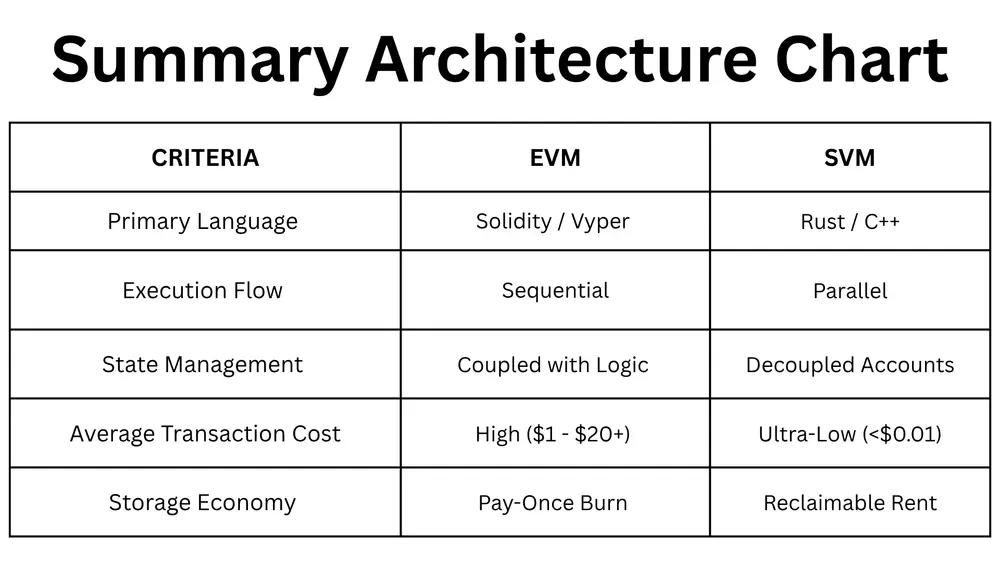
The fundamental developer experience begins with how code is written, compiled, and managed in memory. The EVM and SVM treat smart contract logic and state in fundamentally opposing ways.
Ethereum Virtual Machine (EVM):
- Primary Languages: Solidity, Vyper
- Architecture Type: Coupled State Model
In the EVM, smart contracts are monolithic. A single Solidity contract contains both the executable bytecode and the state variables (variables stored in blockchain storage).
When you write uint256 public totalMinted; in Solidity, that data lives directly inside the balance sheet of that specific contract address. This makes conceptualizing dApps straightforward for developers coming from traditional Object-Oriented Programming (OOP) backgrounds, as a contract acts much like an instanced class object.
Solana Virtual Machine (SVM):
- Primary Languages: Rust, C, C++ (Utilizing the Anchor Framework)
- Architecture Type: Decoupled State Model (Account-Based)
The SVM uses a completely decoupled architecture. On Solana, "smart contracts" are stateless and are explicitly called Programs.
Solana programs do not store data inside themselves; they are strictly read-only logic executables. If a program needs to modify or store data (like a user's token balance), it must create a completely separate Account to hold that data. The program is then granted permission to write to that data account.
Code Comparison: State Allocation
// EVM (Solidity): Logic and State are Coupled
contract TokenStorage {
    // This state variable lives permanently inside this contract
    mapping(address => uint256) public balances;

    function updateBalance(address _user, uint256 _amount) public {
        balances[_user] = _amount;
    }
}
// SVM (Rust/Anchor): Logic is Stateless; State is Passed In Externally
use anchor_lang::prelude::*;

declare_id!("Prog111111111111111111111111111111111111111");

#[program]
pub mut mod token_storage {
    use super::*;
    // The function updates data in an account passed to it from the outside
    pub fn update_balance(ctx: Context<UpdateBalance>, amount: u64) -> Result<()> {
        let balance_account = &mut ctx.accounts.balance_account;
        balance_account.amount = amount;
        Ok(())
    }
}

#[derive(Accounts)]
pub struct UpdateBalance<'info> {
    #[account(mut)]
    pub balance_account: Account<'info, BalanceData>, // Data account passed explicitly
    pub signer: Signer<'info>,
}

#[account]
pub struct BalanceData {
    pub amount: u64, // The data structure definition
}
Developer Takeaway: The SVM's separation of data and logic introduces a steep learning curve. Developers must explicitly pass every single data account a transaction intends to touch into the program at runtime.
2. Execution Speed & Throughput: Single-Threaded vs. Sealevel Parallelization
The defining architectural differentiator between EVM and SVM is how transactions are processed in the memory pool.
EVM: Sequential Execution (The Mempool Bottleneck)
The EVM is a single-threaded state machine. Transactions are processed sequentially (one after another).
Even if Transaction A (Alice sending USDC to Bob) and Transaction B (Charlie minting an NFT) are completely unrelated, they must wait in line.
[Mempool] ---> [Tx A: Alice -> Bob] ---> [Tx B: Mint NFT] ---> [Sequential EVM Block Execution]
This architecture was chosen to eliminate race conditions and reentrancy attacks easily. If two transactions try to modify the exact same state variable at the same time, sequential processing guarantees that one finishes before the next begins. However, this creates a massive scalability bottleneck, limiting Ethereum Layer 1 to roughly 15 Transactions Per Second (TPS).
SVM: Parallel Execution via Sealevel
The SVM utilizes an engine called Sealevel. Because Solana transactions must explicitly declare which data accounts they will read and write to before execution, the runtime can analyze thousands of incoming transactions simultaneously.
If Transaction A and Transaction B do not share any overlapping accounts, the SVM schedules them to run across different CPU cores at the exact same time.
                         ---> [Tx A: Alice -> Bob] ---> [CPU Core 1]
[Transaction]                                                                            ---> [Parallel SVM Execution]
                         ---> [Tx B: Mint NFT] ---> [CPU Core 2]
If multiple transactions attempt to write to the same account (e.g., thousands of users trying to mint from the exact same NFT collection launch), the SVM dynamically switches those specific transactions to sequential mode, while keeping the rest of the network running in parallel. This allows the SVM to reach over 50,000 theoretical TPS.
Runtime Metrics Comparison
| Metric | EVM (Ethereum L1) | SVM (Solana) |
| Execution Engine | Geth / Besu / Reth | Sealevel |
| Threading Model | Single-Threaded (Sequential) | Multi-Threaded (Parallel) |
| Average Block Time | ~12 Seconds | ~400 Milliseconds |
| Time to Finality | ~6 to 12 Minutes (2 Epochs) | ~400ms - 2 Seconds |
| Theoretical TPS | ~15 - 45 | 50,000+ |
3. Economics: Cost to Launch a Contract vs. Program
Deploying code on a decentralized network requires paying for permanent state storage. The financial mechanics behind this differ wildly between the two systems.
EVM Deployment Costs (Pay-Once-Storage)
On the EVM, developers pay a one-time gas fee to deploy smart contract bytecode. The gas fee is calculated based on the size of the compiled bytecode (CREATE or CREATE2 opcodes). Once paid, the contract stays on the blockchain ledger permanently.
- The Problem: This creates a state-bloat problem for validators, who must store this data forever, even if the dApp goes bankrupt or is abandoned.
- Estimated Cost: Depending on mainnet congestion, deploying a standard ERC-20 token can cost anywhere from $50 to $500 USD. Complex DeFi protocols can easily exceed $2,000 - $5,000 USD in deployment costs.
SVM Deployment Costs (The Rent Mechanics)
Solana handles state bloat aggressively through an economic concept called Rent. Because data accounts take up physical space on validator hardware drives, validators require payment for maintaining that space.
When launching an SVM Program or initializing an Account, you must deposit a certain amount of SOL into the account as a Rent-Exemption Deposit.
- Rent Exemption: If an account holds enough SOL to cover 2 years' worth of storage fees, it becomes rent-exempt and will never be purged.
- Reclaimable Rent: Unlike the EVM, where deployment fees are lost forever, Solana rent is fully reclaimable. If you close a data account or migrate a program, you can purge the account from the state and reclaim 100% of the SOL deposited back into your wallet.
- Estimated Cost: Because Rust programs are compiled to BPF (Berkeley Packet Filter) bytecode and are typically larger than EVM bytecode, deploying a program requires allocating space for a buffer. A typical program deployment can require a rent-exemption deposit of 1 to 3 SOL ($150 - $450 USD).
4. Package Management & Ecosystem Tooling
Navigating the developer ecosystem requires knowing what third-party libraries and runtime frameworks are needed to get an application into production.
NPM Packages for EVM Development
EVM node communication is unified under JSON-RPC standards. To compile, test, deploy, and interact with EVM nodes, developers primarily rely on these packages:
ethers/viem: The standard TypeScript libraries for interacting with the EVM JSON-RPC API, parsing ABIs (Application Binary Interfaces), and signing transactions.hardhat/foundry-sh: Command-line development environments. Hardhat relies on Node.js/NPM, while Foundry is built in Rust for faster compilation testing times.@openzeppelin/contracts: The secure industry standard library for pre-tested implementations of ERC-20, ERC-721, and ERC-1155 tokens.
# Core terminal setup for a modern TypeScript EVM project
npm install viem @openzeppelin/contracts
npm install --save-dev hardhat
NPM Packages for SVM Development
Because Solana accounts must be structured perfectly before being fed into a transaction, client-side libraries must do a significant amount of serialization and deserialization work.
@solana/web3.js: The foundational library used to establish JSON-RPC connections to Solana clusters, construct instruction arrays, and manage keypairs.@coral-xyz/anchor: The TypeScript companion package for the Rust Anchor framework. It automatically reads your program's custom IDL (Interface Definition Language) file (Solana's equivalent of an ABI) and auto-generates client methods.@solana/spl-token: The official Node.js package for interacting with Solana's native Program Library tokens (equivalent to ERC-20/ERC-721).
# Core terminal setup for a modern TypeScript SVM project
npm install @solana/web3.js @coral-xyz/anchor @solana/spl-token
Recommended Media Assets for Your Design Team
To maximize readability and engagement for this blog post, you should design and embed the following three graphic illustrations:
Infographic: Coupled vs. Decoupled Architecture
- Left Side: EVM Contract box labeled "Solidity Smart Contract" containing both a gears icon (Logic) and a database icon (Balances Storage) bound inside the same container.
- Right Side: SVM layout showing a stateless block labeled "Solana Program (Executable Bytecode Only)" with distinct directional arrows pointing outwards to multiple independent satellite circles labeled "User Account Data A," "User Account Data B," and "Metadata Account."
Performance Chart: Single-Thread Blockage vs. Multi-Thread Parallel Flow
- Top Visual: A traffic funnel labeled "EVM Mempool" showing mixed transactions (DeFi Swap, NFT Mint, Transfer) squeezed into a single, tight sequential pipeline.
- Bottom Visual: A dynamic processing grid labeled "Solana Sealevel Processing Engine" where incoming transactions are split by color-coded account destinations and fed simultaneously down four parallel tracks.
Code Syntax Comparison Cards
- A side-by-side IDE screenshot or cleanly stylized code panel showing how a simple mapping update requires 5 lines of code in Solidity vs. an explicit structure definition, safe context derivation, and explicit mutation handling in Anchor Rust.
Happy Developing


