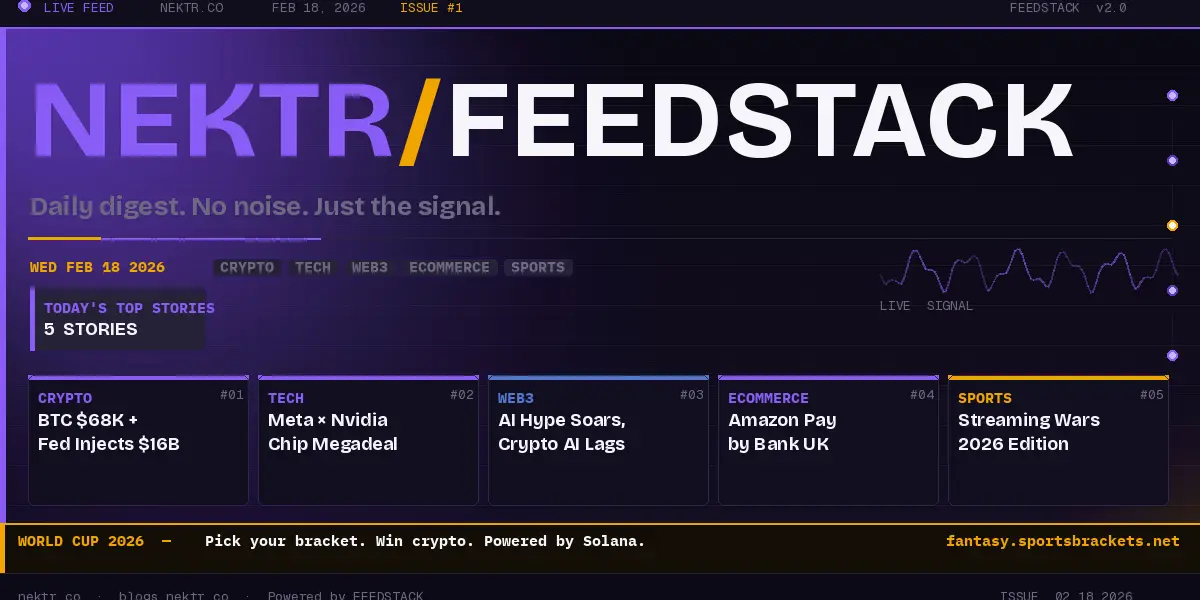
Nektr FEEDSTACK Digest
Five stories shaping crypto, tech, e-commerce, and sports — February 18, 2026.
Wednesday, February 18, 2026 · Powered by Nektr FEEDSTACK
The markets are nervous, AI is eating everything, and e-commerce is quietly reshaping how money moves. Here's what you need to know today — pulled fresh from across the web, summarized so you can stay sharp in under five minutes.
🏆 SPONSORED: $BRACKETS Fantasy — Build Your Dream Team for the 2026 World Cup
$BRACKETS Fantasy is a play-to-earn fantasy sports platform built for the 2026 FIFA World Cup — 48 teams, 104 matches, and a twist: max 3 players per country. You've got a salary cap and virtual cash. It's not just about picking superstars — it's about predicting survival. Your players only score when their teams are still alive. Play free ($0, $1,000 USDC prize pool) or go premium for $10 USDC with 6 chances to win across Group Stage, Round of 32, Round of 16, Super 8, Semi & Final, and Overall Winner. No crypto knowledge required to enter — if you win, they walk you through wallet setup.
👉 Pre-register free at fantasy.sportsbrackets.net — early registrants get guaranteed entry to the free pool + exclusive draft strategy guides.
🪙 #1 — Crypto: Bitcoin at $68K, a Fed Lifeline, and an 11-Year Signal Investors Are Watching
Bitcoin is sitting just under $68,000 today, down about 22% from its January peak — and the crypto market feels it. Stablecoin market cap has shed nearly $10 billion since the year started, DeFi TVL has dropped $20 billion back to pre-election levels, and the altcoin sell pressure has hit a five-year extreme, with cumulative buy/sell delta data sitting at -$209 billion over 13 months. Not pretty.
But here's what's interesting: the BTC/Gold ratio just printed its 11-year generational low — seven straight red monthly candles for the first time ever. Historically, that kind of relative underperformance against gold has preceded major Bitcoin accumulation phases. And against that backdrop, the Federal Reserve announced it's injecting $16 billion in liquidity into the economy this week, which sent traders into a frenzy. Analysts at Motley Fool and standard market watchers are pointing to a stablecoin-to-BTC ratio sitting at 8% — historically a signal that dry powder is ready to deploy.
On the institutional front, Strategy (formerly MicroStrategy) added another 2,486 BTC ($168M) to its treasury, now holding a staggering 717,131 BTC. Meanwhile, billionaire Peter Thiel quietly exited his entire stake in ETHZilla — a sharp reversal from his high-profile 7.5% position last August. Whether that's a loss of faith in corporate Ethereum treasury models or just profit-taking, nobody's saying officially.
Wall Street's most bullish call? Standard Chartered is sticking with $100,000 BTC by late 2026, contingent on regulatory clarity from the Digital Asset Market Clarity Act advancing through Congress. California also just opened its Digital Financial Assets Law licensing window on March 9 — every exchange and custodian serving CA residents needs to be licensed by July 1 or face enforcement. Some smaller players are already eyeing the exit, echoing New York's BitLicense era.
📖 Read more: AMBCrypto — Fed Injection Analysis · Investing News — Market Recap
💻 #2 — Tech: Meta Signs a Multi-Year Nvidia Deal, and AI Is Hitting the Power Grid
In what may be the single most consequential chip deal of 2026, Meta signed a multi-year agreement with Nvidia to deploy millions of chips across its expanding data center footprint — a mix of CPUs and GPUs for current and next-generation model training. When a buyer at Meta's scale commits like this, it doesn't just signal demand; it reshapes supply dynamics, vendor leverage, and the financing structures behind AI infrastructure globally.
The deeper story: AI's compute boom is now forcing a parallel boom in grid software. Google entered the space this week, signaling that grid observability is shifting from niche infrastructure to strategic necessity. The winners here won't be whoever has the flashiest dashboard — they'll be the companies that integrate into utility operations, produce measurable reliability gains, and survive procurement cycles that reward credibility over novelty.
Elsewhere: India is building a $2 billion AI compute hub, Apple is quietly testing AI wearables, and California's regulators are going after autonomy branding in self-driving vehicles — a warning shot for anyone in robotics or AI agents that marketing language can now create legal liability. And Western Digital told investors it's "pretty much sold out" of hard drives for all of 2026, with firm orders stretching into 2028. AI infrastructure is eating every supply chain in its path.
📖 Read more: TechStartups — Top Tech News Feb 18
🌐 #3 — Web3: AI Is Breaking Records on Social — But Crypto AI Tokens Are Getting Left Behind
Here's a divergence worth watching. AI mentions on social media hit all-time records in February 2026, per LunarCrush — 40% of the conversation focused on new models and industry integration, another 30% on creative use cases like art, music, and content. The AI hype machine is running hot.
But decentralized AI projects and blockchain-based AI tokens? Crickets. There's no major social discussion, no top-tier funding allocation, and weak price performance across the board. In Q1 2026, Web3 funding went almost entirely to stablecoin payment infrastructure, custody and trading platforms, real-world asset tokenization, and compliance tools. The "AI x Crypto" thesis that generated so much excitement in 2024 is sitting in the penalty box.
Meanwhile, Bitwise filed for "PredictionShares" ETFs — prediction market-backed funds tied to the 2028 presidential election and upcoming midterms. And the DAO Security Fund (yes, the original 2016 DAO) just decided to stake its untouched ETH and use the yield to fund Ethereum security research — a decade later, still making news.
📖 Read more: Bitcoin Ethereum News — AI vs Crypto
🛒 #4 — E-Commerce: Amazon Launches Pay by Bank in the UK, eBay Live Hits Canada
Amazon just rolled out Pay by Bank in the UK — an account-to-account payment method that lets customers pay directly from their banking app using existing biometrics or PIN. No card required, no card fees, and crucially: refunds process within minutes once Amazon confirms the return. For merchants, this is a signal of where payments infrastructure is heading — lower friction, lower fees, and a creeping erosion of card network dominance.
On the live commerce front, eBay Live expanded to Canada this week, joining the US, Australia, France, Germany, Italy, and the UK. Interactive shopping — where buyers can ask questions and purchase in real-time during a stream — is quietly becoming one of the most important battlegrounds in e-commerce. It's a format built on trust and personality, and eBay is betting it can compete with TikTok Shop and Amazon Live for that attention.
The macro picture is more cautious: the Baird/DC360 Ecommerce Stock Index dropped 5.9% in January, with e-commerce tech stocks down a steep 18%. But Baird analysts are still bullish on 6% industry growth for 2026, pointing to AI-powered shopping tools, the shift toward agentic commerce, and fiscal stimulus tailwinds. Walmart earnings drop tomorrow — that'll be the real temperature check.
📖 Read more: Practical Ecommerce — New Tools Feb 18 · Digital Commerce 360 — Ecommerce Stocks
🏆 #5 — Sports: The Streaming Wars Just Got a 2026 World Cup Angle
The sports media landscape in 2026 is one big game of musical chairs — and the World Cup is the biggest chair at the table. Amazon added The Masters to its Prime Video portfolio this year. Netflix is pushing toward an $83 billion acquisition of Warner Bros. Discovery. YouTube has NFL Sunday Ticket plus rights previously locked to ESPN+ and Peacock. The race isn't just about what games you can show — it's about becoming the app fans open first.
Deloitte's 2026 Sports Industry Outlook frames the shift clearly: AI is becoming foundational infrastructure for sports organizations — not just for fan engagement analytics, but for scouting, player development, crowd safety (IBM's AI was announced for World Cup stadium deployments), and even multilingual commentary. Capital is scaling into multi-club ownership groups that can amortize AI infrastructure costs across leagues and geographies.
The youth sports sector, which became a legitimate PE asset class in 2025, is also drawing attention as a 2026 M&A theme — with video streaming, performance software, and AI-powered training tools seen as the highest-growth verticals.
📖 Read more: Sportico — 2026 Sports Tech Streaming · Deloitte — 2026 Sports Industry Outlook
That's your Nektr FEEDSTACK digest for February 18, 2026. Five stories that moved the needle across crypto, tech, e-commerce, and sports. Bookmark blogs.nektr.co for more.
See you in the next one. 👋


